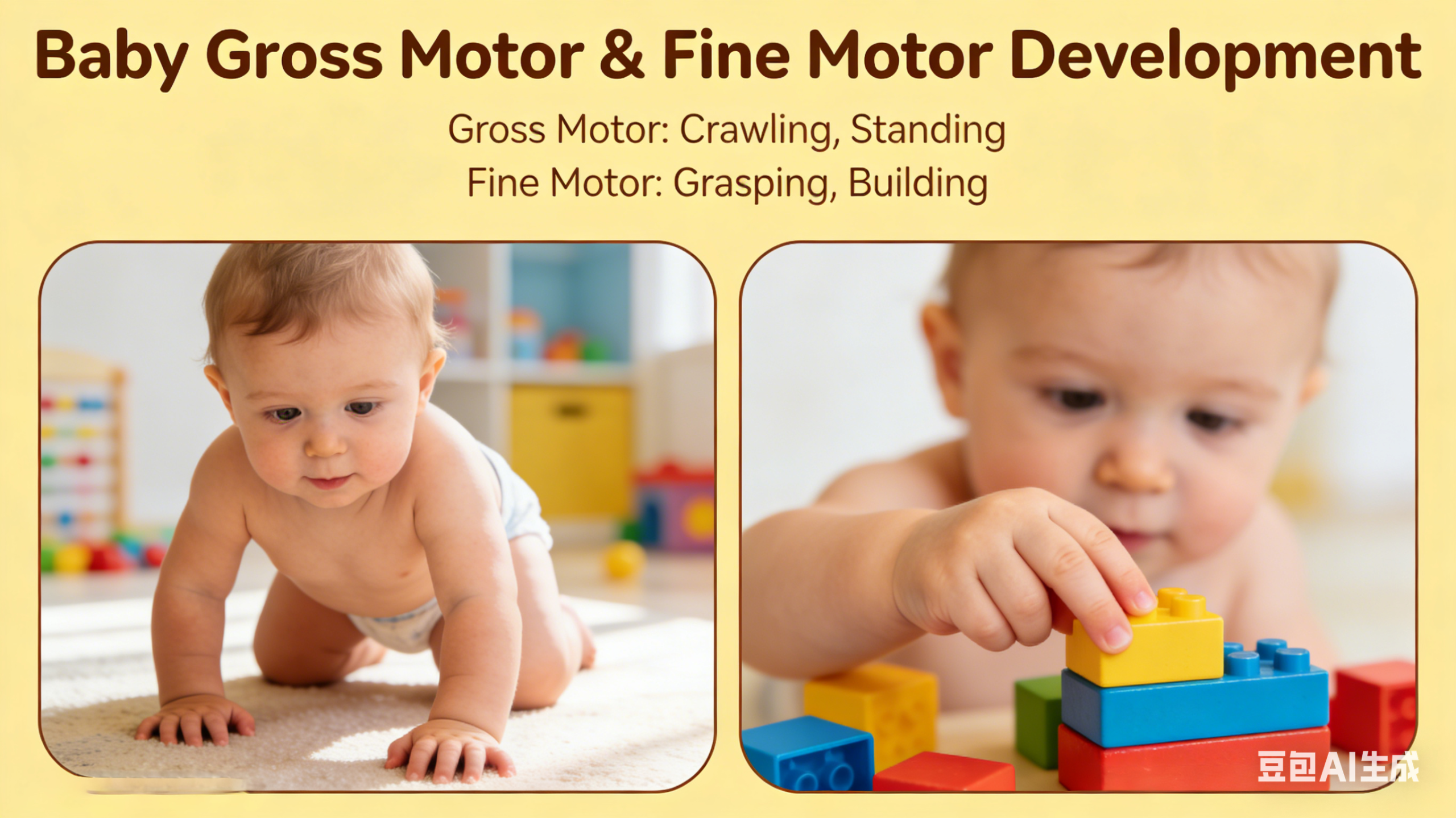




Baby Growth and Development: A Professional Guide to Gross Motor and Fine Motor Skills
From the first lift of the head to the moment your child scribbles with a crayon, motor development unfolds in a predictable sequence. Understanding the typical progression of gross motor skills (large movements) and fine motor skills (small, precise movements) helps parents support their child’s development while recognising when additional support may be beneficial. This guide provides evidence-based information on developmental milestones, patterns, and practical ways to encourage motor skill development.
*Disclaimer: This information is for educational purposes only and does not replace professional medical or developmental advice. Always consult your health visitor, GP, or paediatrician for concerns about your child.*
Part 1: Gross Motor Development
Gross motor skills involve the large muscles of the body—the arms, legs, and trunk—and enable activities like rolling, sitting, crawling, and walking. These skills develop from the head downward (cephalocaudal) and from the centre outward (proximodistal).
1. Typical Gross Motor Milestones
| Age | Milestone | Description |
|---|---|---|
| 0-2 months | Head lifting | When lying on tummy, can lift head briefly (45-degree angle) and turn side to side. Head control remains poor when held upright. |
| 3-4 months | Head control | Holds head steady when supported upright. While on tummy, lifts head to 90 degrees and pushes up on forearms. |
| 4-5 months | Rolling | Begins to roll from tummy to back (usually first) and later from back to tummy. |
| 6 months | Sitting | Sits with support; may sit briefly without support. Begins to bear weight on legs when held upright. |
| 7-8 months | Independent sitting | Sits steadily without support; can reach for toys while maintaining balance. May begin to scoot or crawl. |
| 8-10 months | Crawling | Moves on hands and knees (classic crawling) or using other methods (army crawl, bottom shuffle). Pulls to stand holding onto furniture. |
| 10-12 months | Cruising | Walks while holding onto furniture; stands independently for brief moments. May take first steps alone. |
| 12-14 months | Walking independently | Most children take their first independent steps around 12-13 months, though range is wide (9-18 months). |
| 15-18 months | Running and climbing | Begins to run stiffly; climbs onto furniture; walks up stairs with hand held. |
| 18-24 months | Advanced walking | Walks well; runs smoothly; kicks a ball; attempts to jump with both feet. |
| 2-3 years | Climbing and balance | Walks up and down stairs (alternating feet by age 3); jumps from low steps; stands on one foot briefly. |
2. The Sequence of Gross Motor Development
| Skill | Typical Onset | Key Points |
|---|---|---|
| Head lifting | 1-2 months | Begins with tummy time; strengthens neck and back muscles. |
| Rolling | 4-5 months | Usually tummy-to-back first, then back-to-tummy. |
| Sitting | 6-8 months | Progression from supported to independent sitting. |
| Crawling | 8-10 months | Not all babies crawl—some skip directly to walking. |
| Standing | 8-12 months | Pulls to stand, then stands independently. |
| Walking | 12-15 months | First steps to confident walking over 2-3 months. |
Important note: There is wide individual variation in the timing of motor milestones. A child who is slightly delayed in one area but developing steadily in others often has no underlying issue. However, a consistent pattern of delay across multiple areas warrants discussion with a health professional.
3. How to Support Gross Motor Development
| Age | Strategies |
|---|---|
| Newborn to 3 months | Tummy time: Place baby on tummy for short periods (2-3 minutes) several times daily, gradually increasing. Always supervise. Encourage head turning with toys or your voice. Hold baby upright for brief periods to encourage head control. |
| 3-6 months | Continue tummy time; place toys just out of reach to encourage reaching and rolling. Provide safe floor space for movement. Use pillows or rolled blankets to support sitting (never leave unattended). |
| 6-9 months | Create a safe, open floor area for exploring. Encourage sitting without support. Place toys to the side to encourage twisting and reaching. Avoid prolonged time in bouncers, swings, or car seats. |
| 9-12 months | Provide sturdy furniture for pulling up. Encourage cruising by placing toys just beyond reach. Offer push toys (not walkers, which are unsafe and do not promote walking). |
| 12-24 months | Provide safe climbing opportunities (low steps, cushions). Encourage active play: balls, push toys, toddler slides. Allow plenty of outdoor time for running and exploring. |
What to avoid:
– Baby walkers: These do not help walking and are associated with delayed walking and increased injury risk .
– Excessive container use: Extended time in car seats, bouncers, and swings limits movement opportunities.
– Comparing to peers: Children develop at their own pace; focus on your child’s progress.
4. When to Seek Help
Contact your health visitor or GP if your baby:
– Cannot hold head steady by 4 months
– Does not reach for or grasp objects by 5 months
– Does not roll by 6-7 months
– Cannot sit without support by 9 months
– Does not bear weight on legs by 9 months
– Does not crawl or move across floor by 12 months
– Has not taken first steps by 18 months
– Loses previously acquired motor skills
Part 2: Fine Motor Development
Fine motor skills involve the small muscles of the hands and fingers, enabling precise movements like grasping, manipulating objects, and eventually writing. These skills develop from reflexive grasping to purposeful, coordinated movements.
1. Typical Fine Motor Milestones
| Age | Milestone | Description |
|---|---|---|
| 0-2 months | Grasp reflex | Hands are mostly fisted; fingers curl reflexively around objects placed in palm. |
| 3 months | Reaching | Begins to swipe at dangling objects; hands start to open more frequently. |
| 4 months | Purposeful reaching | Reaches toward objects with both hands; brings hands together. |
| 5-6 months | Palmar grasp | Uses entire palm to grasp objects; begins transferring objects between hands. |
| 7-8 months | Raking grasp | Uses fingers to rake small objects toward self; begins to poke and point. |
| 8-10 months | Pincer grasp emerging | Uses thumb and index finger to pick up small objects; still uses raking motion initially. |
| 10-12 months | Refined pincer grasp | Picks up small objects with thumb and fingertip; drops objects intentionally; puts objects into containers. |
| 12-15 months | Building | Stacks 2-3 blocks; scribbles with crayon; turns pages of board books. |
| 15-18 months | Manipulation | Stacks 3-4 blocks; uses spoon with spillage; removes socks and hats. |
| 18-24 months | Precision | Stacks 4-6 blocks; scribbles in circular motion; turns pages one at a time; opens containers. |
| 2-3 years | Advanced manipulation | Builds tower of 6-8 blocks; uses child-safe scissors; draws circles and lines; strings beads. |
2. The Progression of Fine Motor Skills
| Skill | Progression |
|---|---|
| Grasp | Reflex grasp → palmar grasp → raking → pincer grasp → refined pincer (thumb to fingertip) |
| Hand use | Fisted → reaching → two-handed → transferring between hands → tool use |
| Object manipulation | Holds → shakes → drops → releases intentionally → stacks → builds |
| Drawing | Random marks → controlled scribble → lines → circles → shapes → letters |
Key concept: The pincer grasp—using the thumb and index finger—is a critical fine motor milestone that enables more precise manipulation of small objects and is the foundation for writing skills later.
3. How to Support Fine Motor Development
| Age | Strategies |
|---|---|
| 0-3 months | Offer safe, textured objects to touch. Provide opportunities for hand-opening (gentle massage, different textures). Place toys within reach during tummy time. |
| 3-6 months | Offer easy-to-hold toys (rattles, teethers). Encourage reaching and batting. Place toys on high chair tray for exploration. |
| 6-9 months | Provide finger foods (soft pieces of cooked vegetables, banana) to encourage self-feeding. Offer containers for filling and emptying. Introduce stacking cups and simple shape sorters. |
| 9-12 months | Offer small, safe objects for pincer practice (puffed cereal, soft peas). Provide books with flaps and textures. Encourage self-feeding with spoon. |
| 12-18 months | Provide chunky crayons and paper for scribbling. Offer large beads for threading. Encourage stacking and building. Play with playdough (supervised). |
| 18-24 months | Introduce child-safe scissors (supervised). Provide puzzles with knobs. Encourage dressing practice (Velcro shoes, large buttons). Offer drawing and painting materials. |
| 2-3 years | Provide small beads, lacing cards, and building sets. Encourage drawing with crayons, markers, and chalk. Involve child in kitchen activities (stirring, pouring). |
Everyday opportunities:
– Mealtimes: Self-feeding with fingers, then utensils
– Bath time: Pouring, squeezing, and scooping
– Play: Building, puzzles, art, and sensory play
– Dressing: Practising buttons, zippers, and fasteners
4. What to Watch For
Common fine motor challenges:
– Hand dominance: Most children do not show clear hand preference until age 2-3. Early consistent preference (before 18 months) may indicate weakness on the non-dominant side and should be discussed with a health professional.
– Hand strength: Difficulty using scissors, holding crayons, or manipulating small objects may suggest hand weakness.
– Coordination: Trouble with tasks requiring two hands together (e.g., holding a toy with one hand while manipulating with the other) may indicate coordination difficulties.
5. When to Seek Help
Contact your health visitor or GP if your baby:
– Does not reach for objects by 4-5 months
– Cannot transfer objects between hands by 7 months
– Does not use a raking or pincer grasp by 10-12 months
– Cannot stack 2 blocks by 15 months
– Shows consistent hand preference before 18 months
– Has difficulty using utensils or drawing by 2-3 years
– Loses previously acquired fine motor skills
Summary: Motor Development at a Glance
| Age | Gross Motor Milestones | Fine Motor Milestones |
|---|---|---|
| 0-3 months | Lifts head during tummy time | Grasp reflex; hands fisted |
| 3-6 months | Rolls over; sits with support | Reaches; palmar grasp; transfers objects |
| 6-9 months | Sits without support; begins to crawl | Raking grasp; picks up small objects |
| 9-12 months | Crawls; pulls to stand | Pincer grasp; puts objects in container |
| 12-18 months | Walks independently; climbs | Stacks blocks; scribbles; uses spoon |
| 18-24 months | Runs; kicks ball | Stacks 4-6 blocks; turns pages; draws lines |
| 2-3 years | Jumps; walks up stairs | Builds towers; uses scissors; draws circles |
**Key Resources:**
– NHS Start for Life: www.nhs.uk/start-for-life
– ICAN (early language and communication): www.ican.org.uk
– Royal College of Paediatrics and Child Health: www.rcpch.ac.uk
*References available upon request. Key sources: 浙江省立同德医院 , AAP guidelines , 南充市中心医院 , 卓正科普 .*
a.本站所有文章,如无特殊说明或标注,均为本站原创发布。
b.任何个人或组织,在未征得本站同意时,禁止复制、盗用、采集、发布本站内容到任何网站、书籍等各类媒体平台。
c.如若本站内容侵犯了原著者的合法权益,可联系我们进行处理。








No comments yet