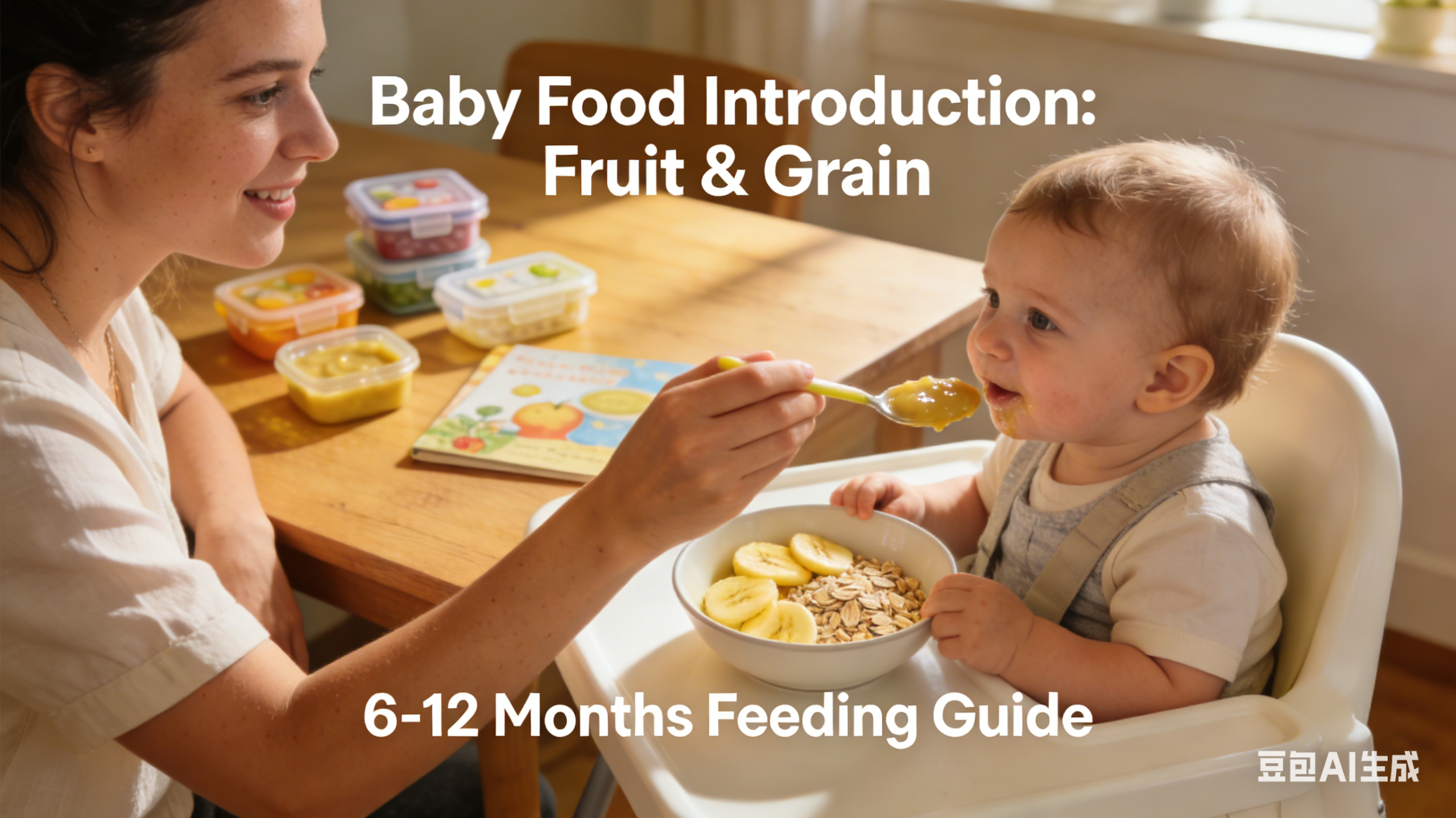




Baby Complementary Feeding: A Professional Guide to Introducing Fruit and Grains
Fruit and grains are important components of a balanced weaning diet, providing essential vitamins, minerals, energy, and fibre. Understanding how to introduce them safely helps support your baby’s growth and encourages healthy eating habits. This guide provides evidence-based information on introducing fruit and grains to babies from around 6 months.
*Disclaimer: This information is for educational purposes only and does not replace professional medical advice. Always consult your health visitor, GP, or paediatrician for concerns about your baby.*
Part 1: Introducing Fruit
1. When Can Babies Start Eating Fruit?
Solid foods, including fruit, should be introduced from around **6 months** of age, alongside breast milk or first infant formula. By this age, babies can sit up with support, coordinate hand-to-mouth movements, and swallow food effectively. The NHS advises starting with vegetables that aren’t so sweet, such as broccoli, cauliflower and spinach, to help your baby get used to a range of tastes (rather than just the sweeter ones), which can help prevent them being fussy eaters as they grow up.
What to watch for (signs of readiness for solids) :
– Your baby can sit up with support and has good head control
– Your baby shows interest in eating, for example, watching and reaching out when they see food
– Your baby can pick up food and aim for their mouth
– Your baby can swallow food (not just push it out)
2. How to Prepare Fruit for Your Baby
The NHS recommends mashing or blending soft ripe fruits to a suitable texture for your baby, or offering them as finger foods. Harder fruits will need to be cooked to soften them. Always wash fruit and remove any pips, stones and hard skin before serving.
| Fruit Type | Preparation Method |
|---|---|
| Soft fruits (banana, avocado, ripe peach, mango) | Mash with a fork or blend; no cooking needed |
| Harder fruits (apple, pear) | Cook (steam, boil, or bake) until soft, then mash or blend |
| Berries (blueberries, raspberries, strawberries) | Wash well; mash or blend to a smooth texture |
| Stone fruits (peach, nectarine, plum) | Remove stone, cook if needed, mash or blend |
Texture progression:
– 6-7 months: Smooth puree
– 7-9 months: Mashed with small soft lumps
– 9-12 months: Soft finger food pieces
Safety note: Whole grapes, cherry tomatoes, and similar-sized fruits present a choking hazard and should be cut lengthways into quarters before serving to older babies.
3. Does Fruit Need to Be Steamed or Cooked?
It depends on the fruit. The NHS guidance states that if the fruit is already soft (like banana, ripe peach, or avocado), no cooking is required—simply mash and serve. Harder fruits like apple and pear need to be cooked to soften them before they can be safely mashed or blended for a young baby.
Some sources suggest that steaming fruits for babies under 8 months can help break down sugars and fibres, making them easier to digest. However, there is no hard and fast rule—the most important consideration is ensuring the fruit is soft enough for your baby to manage safely without choking.
4. Can Babies Drink Freshly Squeezed Juice? Is There a Problem?
Freshly squeezed fruit juice is not recommended for babies under 1 year unless advised by a doctor for managing constipation.
Why juice is problematic:
– High sugar content: Fruit juice contains natural sugars that can cause tooth decay
– Lack of fibre: The juicing process removes the fruit pulp, which contains most of the fibre and many nutrients
– Reduced nutritional value: Whole fruit provides more vitamins, minerals, and antioxidants than juice
– Filling effect: Juice can fill a baby’s small stomach, reducing appetite for more nutritious foods like breast milk, formula, or solid meals
– Acidic nature: Fruit juices are acidic and can damage tooth enamel
If you do choose to give juice (for older babies over 1 year):
– Dilute well — one part juice to 10 parts water
– Offer only at mealtimes, not as a between-meal drink
– Limit to small amounts
– Continue diluting juice until your child is 5 years old
Remember: The best drinks for babies after 6 months are water and breast milk or formula.
5. What Is the Best Time of Day to Give Fruit?
There is no single “best” time. However, some feeding principles can help:
– Introduce new foods in the **morning** so you can observe any reactions during the day
– Offer fruit **30-45 minutes after the main meal** or as a separate snack about 2-3 hours before or after a main meal
– Avoid giving fruit **right before a main meal**, as it may fill your baby up and cause refusal of the main meal
– Some sources suggest that the morning is ideal for fruit consumption, as the body absorbs nutrients well after a night’s sleep
In practice, many parents offer fruit as part of breakfast, as a mid-morning snack, or as a pudding after lunch.
6. Can Babies Eat Raw Fruit?
Yes, but with caution. Soft, ripe fruits such as banana, avocado, ripe peach, and mango can be given raw from 6 months, simply mashed or offered as finger foods. Harder fruits like apple and pear should be cooked until soft for younger babies (6-9 months). As your baby gets older (around 9-12 months) and develops better chewing skills, you can offer finely grated raw apple or very thinly sliced raw pear.
Always:
– Remove pips, stones, and hard skin
– Cut round fruits like grapes and cherry tomatoes lengthways into quarters to prevent choking
– Supervise your baby closely during eating
Part 2: Introducing Grains (Starchy Foods)
1. When Can Babies Start Eating Grains?
Grains (starchy foods) can be introduced from **around 6 months** alongside other first foods. The NHS recommends that starchy foods can be cooked (where necessary), mashed or blended to a suitable texture for your baby, or offered as finger foods.
Grains suitable from 6 months include: baby rice, bread, chapatti, cornmeal, maize, millet, oatmeal, oats, pasta, pitta bread, porridge, potato, quinoa, rice, sweet potato, toast.
How to prepare cereals: Mix with breast milk, first infant formula, or (if your baby is over 6 months) pasteurised whole (full-fat) cows’ milk, goats’ or sheep’s milk [13†L41-L43].
2. Can Babies Under 1 Year Eat Whole Grains and Brown Rice?
Yes, but in moderation. Whole grains such as wholemeal bread, brown rice, and wholemeal pasta can be introduced from around 6 months, but there are important considerations.
Key NHS advice: It is **not a good idea to only give wholegrain starchy foods to under-2s**. Wholegrain foods can be high in fibre and may fill your child up before they have taken in the calories and nutrients they need. For babies and young children, who have small stomachs, it is important that the foods they eat provide enough energy and nutrients for growth. High-fibre foods can be filling without providing sufficient calories.
Practical recommendations:
– Offer a **mixture of wholegrain and refined grains** until your child is at least 2 years old
– Start with easily digestible grains like oats, rice, and millet
– Prepare whole grains as smooth purees or soft mashes for younger babies
– White bread, pasta, and rice are also fine in small amounts
NHS bread recommendations:
– You can give your baby small amounts of wholemeal bread, but not all of their starchy foods should be wholegrain
– White bread still contains a range of vitamins and minerals, and less fibre than wholemeal bread—it is fine to feed white bread to your baby in small amounts
– Avoid breads with seeds (choking hazard), added salt, added sugar, or hard crusts
– Introduce bread when your baby is eating 2-3 meals a day (typically 7-9 months)
3. What If My Baby Refuses Grains or Cereals?
This is common and usually not a cause for concern. Remember that solid food is still just an “extra” at 6 months—breast milk or formula remains your baby’s main source of nutrition.
Practical strategies:
| Problem | Solution |
|---|---|
| Baby refuses plain cereal | Mix cereal with breast milk or formula for familiar taste; try mixing with fruit or vegetable puree that baby already likes |
| Baby dislikes the texture | Adjust consistency (smoother or slightly thicker); try different grains (oat, rice, millet) |
| Baby refuses all grains | There is no reason cereal needs to be the first solid. Offer other iron-rich foods like pureed meat, fish, eggs, or legumes instead |
| Baby consistently refuses | Offer new foods during the morning when you can observe reactions; follow the “four day wait” rule when introducing new foods |
| Baby only wants breast milk | Try baby-led weaning—some babies prefer finger foods over purees and cereals |
Important: Avoid forcing or pressuring your baby to eat. Trust your baby to eat as much or as little as they want. If refusal persists, take a break for a few days and try again.
4. Can Babies Eat Pasta, Bread, and Rice?
**Yes, from around 6 months** as part of a varied diet.
| Food | Age | Preparation |
|---|---|---|
| Pasta | From 6 months | Cook until very soft; cut into small pieces or offer as finger food |
| Rice | From 6 months | Cook until very soft; mash or blend to appropriate texture; offer as part of meals |
| Bread | From 7-9 months | Offer small pieces of soft bread (white, wholemeal, pitta); avoid crusty bread initially; remove crusts if too hard |
Bread safety checklist:
– Check labels for salt content (aim for less than 1g salt per 100g)
– Avoid breads with added sugar (brioche, sweet breads)
– Avoid seeded breads that could present a choking hazard
– Start with softer breads like white bread, pitta, or soft wholemeal bread
5. What About Gluten?
Gluten is found in wheat, barley, rye, and some oats. Current UK guidance recommends introducing allergenic foods, including gluten-containing grains, **from around 6 months** alongside other solid foods. There is no evidence that delaying introduction beyond 6 months reduces the risk of developing coeliac disease or wheat allergy.
How to introduce gluten:
– Offer small amounts of wheat-based foods such as baby rice cakes, soft toast, pasta, or wheat-based cereal
– Introduce gluten-containing grains one at a time
– Monitor for any signs of allergic reaction (rash, vomiting, diarrhoea, swelling)
Summary: Key Points at a Glance
| Topic | Key Messages |
|---|---|
| Starting fruit | From 6 months; mash or blend soft ripe fruits; cook harder fruits |
| Fruit juice | Not recommended under 1 year (except for constipation); contains sugar, lacks fibre |
| Best time for fruit | Morning or as a snack between meals; avoid right before main meals |
| Raw fruit | Soft ripe fruit is fine raw; harder fruit should be cooked for younger babies |
| Starting grains | From 6 months; mix cereals with breast milk, formula, or whole milk (over 6 months) |
| Whole grains for under-2s | Offer in moderation; do not make them the only starchy food (risk of filling up on fibre) [19†L23-L25] |
| Baby refuses grains | Try mixing with familiar foods; there is no need to force—offer other iron-rich foods instead |
| Gluten introduction | From around 6 months; there is no benefit to delaying |
| Bread for babies | From 7-9 months; choose low-salt, no added sugar; avoid seeded and hard crusty breads |
Key Resources:
– NHS Best Start in Life: www.nhs.uk/best-start-in-life
– First Steps Nutrition Trust: www.firststepsnutrition.org
– British Dietetic Association: www.bda.uk.com
*References available upon request. Key sources: NHS Best Start in Life, Department for Education EYFS Nutrition Guidance (2025), NHS What to Feed Young Children, First Steps Nutrition Trust.*
a.本站所有文章,如无特殊说明或标注,均为本站原创发布。
b.任何个人或组织,在未征得本站同意时,禁止复制、盗用、采集、发布本站内容到任何网站、书籍等各类媒体平台。
c.如若本站内容侵犯了原著者的合法权益,可联系我们进行处理。


No comments yet