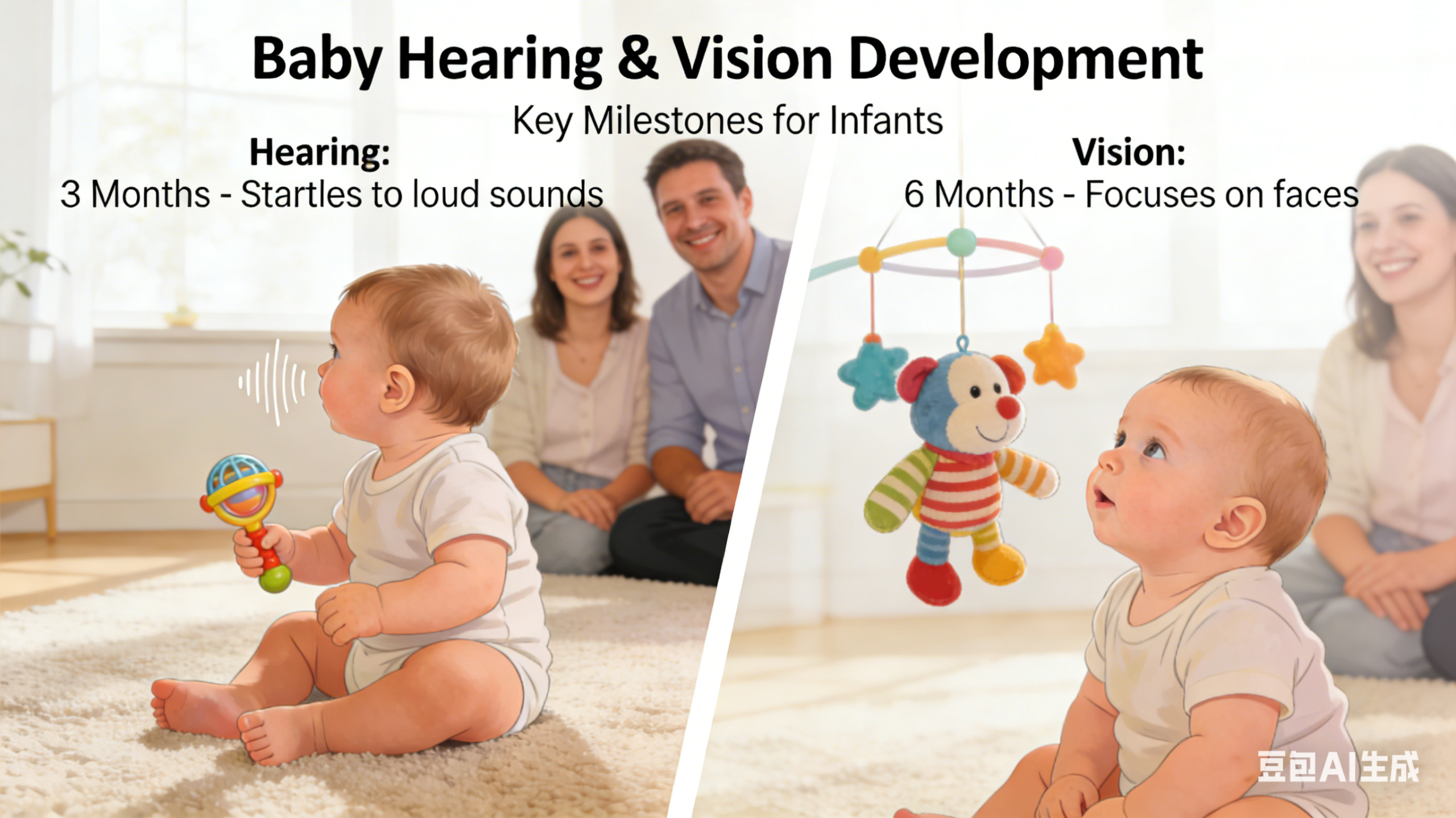




Baby Growth and Development: A Professional Guide to Hearing and Vision Development
From the moment of birth, your baby’s senses are awakening to the world. Hearing is fully functional at birth, while vision develops more gradually over the first year. Understanding the typical milestones for hearing and vision helps parents support their baby’s sensory development and recognise when to seek professional advice. This guide provides evidence-based information on how hearing and vision develop, how to support each, and answers to common questions.
*Disclaimer: This information is for educational purposes only and does not replace professional medical advice. Always consult your health visitor, GP, or paediatrician for concerns about your baby’s development.*
Part 1: Hearing Development
1. When Does Hearing Begin?
Hearing develops early in fetal development and is fully functioning at birth. Research shows that unborn babies can hear and remember sounds while in the womb. In one study, pregnant women read a story aloud twice daily; after birth, 13 of 16 infants stopped sucking when they heard their own mother reading that same story, demonstrating recognition of familiar sounds . This means your baby has been listening to your voice for months before birth.
2. Hearing Development Milestones
The following milestones represent typical hearing and speech development. Not every child follows the exact timeline, but these markers help guide expectations.
| Age | Milestones |
|---|---|
| Birth to 3 months | Reacts to loud sounds with startle reflex (blinking, crying, or startling) . Is soothed and quieted by soft sounds . Turns head toward familiar voices . Recognises parent’s voice and may quiet when spoken to . Makes vocal sounds other than crying . |
| 4 to 6 months | Looks or turns toward new sounds . Responds to “no” and changes in tone of voice . Begins to repeat sounds (“ooh,” “aah,” “ba-ba”) . Enjoys rattles and toys that make sounds . Laughs and makes squealing sounds . |
| 7 to 12 months | Responds to own name, telephone ringing, or someone’s voice even when not loud . Knows words for common things (“cup,” “shoe”) . Babbles with repetitive sounds (“mama,” “baba”) . Responds to simple requests (“come here”) . Enjoys games like peek-a-boo and pat-a-cake . Looks at things or pictures when someone talks about them . |
| 1 to 2 years | Follows simple commands (“give me the book”) . Uses words he or she has learned often . Points to body parts when asked . Understands simple questions (“Are you hungry?”) . Uses 2-3 word sentences . Understands “not now” and “no more” . Follows 2-step commands (“Get your shoes and come here”) . |
| 2 to 3 years | Says about 50 words . Uses 2 or more words with action words (“Doggie run”) . Asks simple questions (“Where is my ball?”) . Talks well enough for others to understand most of the time . |
3. How to Support Your Baby’s Hearing Development
| Age | Strategies |
|---|---|
| Newborn to 3 months | Talk and sing to your baby frequently; your voice is their favourite sound . Respond to coos and sounds to encourage vocalisation . Use a calm, soothing tone when comforting . |
| 4 to 6 months | Play with rattles and toys that make sounds . Imitate the sounds your baby makes to encourage turn-taking . Speak with varied tones and pitches to maintain interest . |
| 7 to 12 months | Call your baby by name frequently . Name objects and actions throughout the day (“Look, a dog!” “Time for your bath”) . Read books aloud daily, using different voices for characters . Play sound-location games (shake a rattle in different spots) . |
| 1 to 2 years | Expand on your child’s words (“You said ball. Yes, that’s a red ball!”) . Give simple, clear instructions and praise compliance . Sing songs with actions (Wheels on the Bus, If You’re Happy and You Know It) . |
4. When to Seek Help
Contact your health visitor or GP if your baby:
– Does not startle or react to loud sounds by 3 months
– Does not turn toward sounds by 4-6 months
– Does not babble by 9 months
– Does not respond to own name by 12 months
– Does not use any words by 18 months
– Loses previously acquired speech or hearing abilities
Part 2: Vision Development
1. How Vision Develops: A Timeline
A baby’s vision improves dramatically during the first year. Unlike hearing, which is fully functional at birth, vision develops gradually as the brain learns to process visual information.
Newborn to 2 months:
– Can see light, shapes, and faces, but vision is blurry beyond about 20-30 cm (8-12 inches) — roughly the distance from your face during feeding .
– Prefers high-contrast patterns (black and white) and simple shapes .
– Eyes may occasionally wander, cross, or move randomly; this should improve by 2-3 months .
– Begins to track moving objects briefly .
3 to 4 months:
– Focuses on faces and close objects .
– Follows moving objects with eyes (smooth tracking) .
– Begins to see colours more clearly and prefers red, blue, and yellow .
– Reaches for objects within sight .
5 to 6 months:
– Can see small objects (like buttons) .
– Vision improves to about 20/100 (0.2) .
– Depth perception begins to develop .
– Can distinguish between different objects and use visual information to identify them .
7 to 12 months:
– Vision continues to improve (20/50 to 20/70) .
– Can track fast-moving objects .
– Recognises familiar faces from across a room .
– Develops hand-eye coordination to grasp small objects .
1 to 2 years:
– Vision approaches adult levels (20/25 to 20/30) .
– Can recognise themselves in mirrors .
– Points to objects in picture books .
– Depth perception fully developed .
3 to 5 years:
– Vision reaches 20/20 or near-adult levels .
– Can recognise shapes, colours, and letters .
– Binocular vision (using both eyes together) is fully coordinated .
2. How to Support Your Baby’s Vision Development
| Age | Strategies |
|---|---|
| Newborn to 2 months | Use high-contrast black-and-white patterns, toys, and books . Hold baby close (within 30 cm) to help them focus on your face . Vary baby’s position in the cot to expose them to different perspectives . Use a night light so baby has visual stimulation when waking . |
| 3 to 4 months | Introduce colourful toys and mobiles . Play games that encourage tracking (slowly move a toy from side to side) . Offer safe mirrors for self-discovery . Give baby time to look around in different environments . |
| 5 to 6 months | Provide objects of different sizes, shapes, and textures for exploration . Encourage reaching and grasping . Use picture books with clear, simple images . Allow supervised tummy time to strengthen neck and eye muscles . |
| 7 to 12 months | Play peek-a-boo and hide-and-seek with objects . Read books together, pointing to pictures and naming them . Provide stacking toys, blocks, and simple puzzles . Encourage crawling and movement to develop hand-eye coordination . |
| 1 to 2 years | Read books daily; let baby turn pages . Play simple matching games (find the ball, find the red block) . Draw and scribble together with chunky crayons . Point out objects in the distance (cars, birds, trees) . |
3. Does My Baby Have “Crossed Eyes”? Understanding Pseudostrabismus
A common concern among parents is whether their baby has “crossed eyes” (strabismus). In many cases, what appears to be inward turning is actually **pseudostrabismus** (false strabismus), a normal variation.
Pseudostrabismus (common, not a problem):
– Caused by a flat nasal bridge or extra skin folds (epicanthal folds) at the inner corners of the eyes, which make the eyes appear turned inward even when they are properly aligned .
– Eyes move together normally when tracking objects .
– No signs of true misalignment .
– Usually resolves as the nasal bridge develops (typically by 2-3 years) .
True strabismus (requires evaluation):
– One eye consistently turns inward, outward, up, or down .
– Eyes do not move together when following objects .
– Child may tilt head or squint to see clearly .
– If untreated, can lead to amblyopia (lazy eye) and permanent vision problems .
How to tell the difference: A simple test involves shining a light at the bridge of the nose while looking at the reflection in each pupil. If the light reflects in the same position in both pupils (both centrally located), the eyes are aligned. If one reflection is off-centre, true strabismus may be present .
When to seek help: If you notice persistent eye turning, if one eye appears misaligned constantly, or if your child tilts their head consistently to see, consult your GP or health visitor. True strabismus is best treated early (before age 6) for optimal outcomes.
4. Foods That Support Vision Development
Proper nutrition supports healthy eye development. Key nutrients include:
| Nutrient | Role | Food Sources |
|---|---|---|
| Vitamin A | Essential for night vision and corneal health | Carrots, sweet potatoes, spinach, kale, pumpkin, egg yolks, liver |
| Omega-3 fatty acids (DHA) | Supports retinal development; helps prevent dry eye | Oily fish (salmon, mackerel, sardines), fortified foods |
| Vitamin C | Protects eye tissues; supports blood vessel health | Oranges, strawberries, kiwi, bell peppers, broccoli |
| Vitamin E | Antioxidant protecting eye cells | Nuts, seeds, spinach, avocado |
| Zinc | Helps vitamin A move from liver to retina; supports night vision | Beef, pork, beans, nuts, whole grains |
| Lutein and zeaxanthin | Protect the macula from damage | Kale, spinach, corn, eggs |
Note: For babies under 12 months, breast milk or formula provides complete nutrition. Solid foods should be introduced from 6 months, and these nutrient-rich foods can be offered as age-appropriate purees or finger foods.
5. Warning Signs: When to Seek Help
Contact your GP, health visitor, or optometrist if your baby:
– Does not track moving objects by 3 months
– Eyes constantly wander, cross, or do not move together by 4 months
– One eye appears turned inward or outward persistently
– Does not reach for objects by 6 months
– Shows extreme sensitivity to light (beyond typical squinting)
– Has pupils that appear white or cloudy (possible cataract)
– Frequently rubs eyes excessively
– Tilts head consistently to look at objects
– Has eyes that appear different in size or shape
Summary: Key Points at a Glance
| Topic | Key Messages |
|---|---|
| Hearing | Fully functional at birth. Milestones include startling to loud sounds (0-3m), turning to sounds (4-6m), babbling (6-9m), and first words (12-15m). |
| Vision | Develops gradually. Newborns see 20-30 cm; by 6 months vision is 20/100; by 3-5 years reaches 20/20 . |
| Promoting hearing | Talk, sing, read, and respond to vocalisations. Limit background noise for focused listening. |
| Promoting vision | Use high-contrast toys, encourage tracking, read books, ensure safe outdoor time for distance vision. |
| Crossed eyes | Often pseudostrabismus (normal) due to nasal bridge shape; true strabismus requires evaluation. |
| Nutrition | Vitamin A, omega-3s, vitamin C, zinc, and lutein-rich foods support eye health . |
**Key Resources:**
– NHS Start for Life: www.nhs.uk/start-for-life
– Royal National Institute of Blind People (RNIB): www.rnib.org.uk
– National Deaf Children’s Society: www.ndcs.org.uk
– Association of Optometrists: www.aop.org.uk
*References available upon request. Key sources: Johns Hopkins Medicine , American Academy of Pediatrics , 医药卫生报 , 東元綜合醫院 , AccessPediatrics .*
a.本站所有文章,如无特殊说明或标注,均为本站原创发布。
b.任何个人或组织,在未征得本站同意时,禁止复制、盗用、采集、发布本站内容到任何网站、书籍等各类媒体平台。
c.如若本站内容侵犯了原著者的合法权益,可联系我们进行处理。



No comments yet