



Newborn Care: A Professional Guide to Daily Essentials
Caring for a newborn can feel overwhelming, but understanding the basics of daily care helps build confidence and ensures your baby’s health and comfort. This guide covers essential aspects of newborn care based on current evidence-based recommendations.
*Disclaimer: This information is for educational purposes only and does not replace professional medical advice. Always consult your health visitor, midwife, or GP for concerns about your baby.*
1. Umbilical Cord Care
Definition: The umbilical cord stump typically falls off naturally within 1-3 weeks after birth.
Care guidelines:
– Keep the area **clean and dry**.
– Fold nappy below the stump to allow air circulation.
– Sponge bath only until stump falls off (avoid submerging in water).
– No need to use alcohol or antiseptics unless advised by healthcare provider.
– Allow stump to fall off naturally – **do not pull or tug**.
Signs of infection (seek medical advice):
– Redness, swelling, or warmth around the base
– Yellowish pus or foul odour
– Bleeding (more than a few drops)
– Baby fever or lethargy
2. Bathing
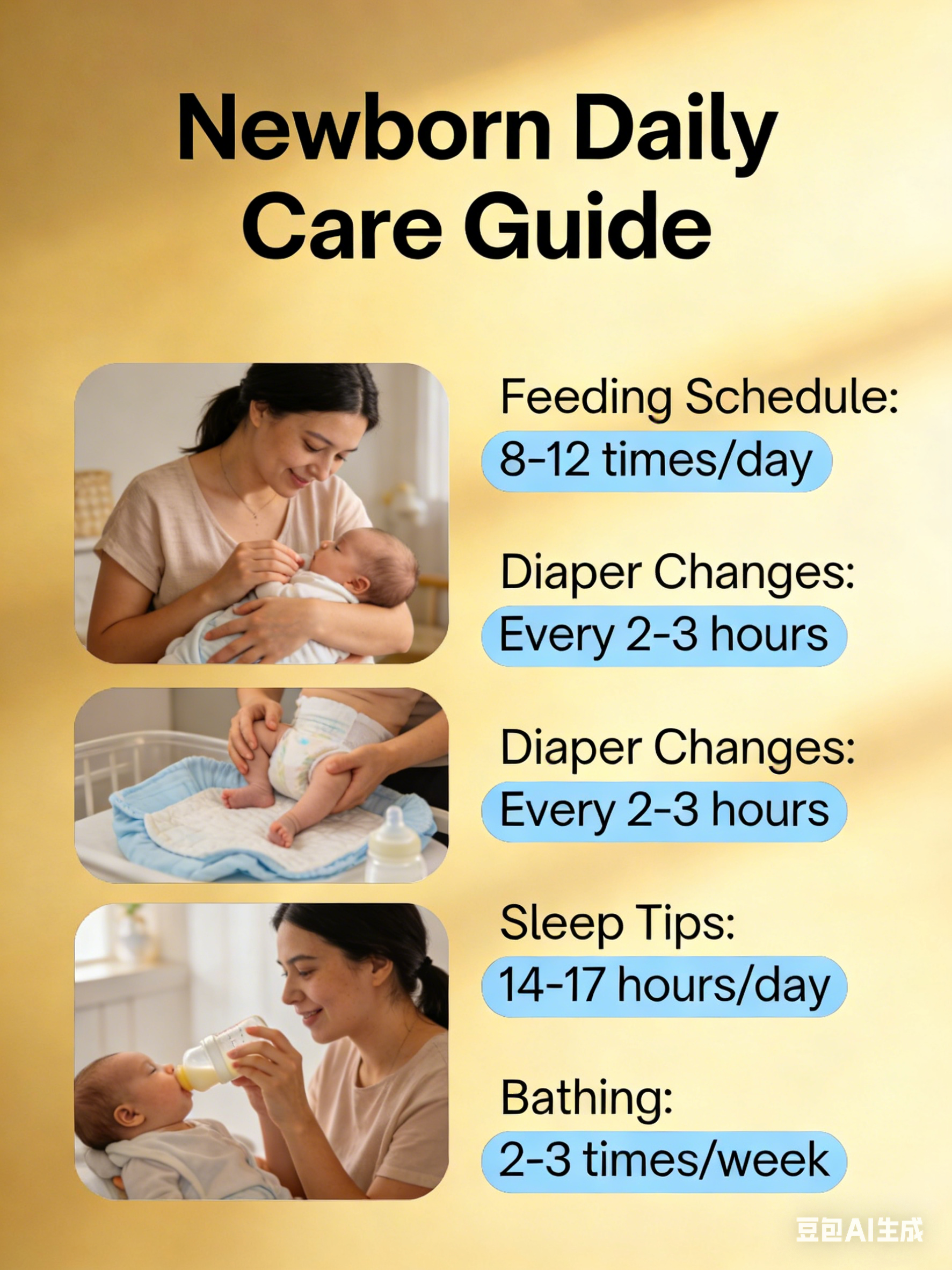
Frequency: 2-3 times per week is sufficient for newborns; more frequent bathing can dry out delicate skin.
Sponge bathing (until cord falls off):
– Use warm water (check temperature with elbow – should feel comfortably warm, not hot).
– Place baby on a safe, flat surface (changing mat or towel).
– Wash face first with clean water, then body with mild, fragrance-free cleanser.
– Keep baby covered except the area being washed to prevent chilling.
– Pat dry thoroughly, especially skin folds.
Tub bathing (after cord falls off):
– Fill tub with 5-8 cm of warm water (37-38°C).
– Always test water temperature before placing baby in.
– Support baby’s head and neck throughout.
– Never leave baby unattended – even for a second.
– Clean from cleanest to dirtiest areas (face first, nappy area last).
Products: Use pH-neutral, fragrance-free, hypoallergenic products designed for newborns.
3. Nappy Care
Changing frequency: Newborns need 8-12 nappy changes per day.
Signs of adequate wet nappies:
– Day 1-2: At least 1-2 wet nappies
– Day 3-4: At least 3-4 wet nappies
– Day 5+: At least 5-6 heavy wet nappies every 24 hours
Nappy changing steps:
1. Gather supplies: clean nappy, wipes (water-based or cotton wool with water), nappy cream (if needed).
2. Clean front to back (especially important for girls to prevent urinary tract infections).
3. Allow skin to air dry briefly before putting on fresh nappy.
4. Apply barrier cream if skin looks red or irritated.
5. Fasten nappy snugly but not too tight – you should be able to fit two fingers at the waist.
Nappy rash prevention:
– Change nappies frequently
– Clean gently, avoid harsh wipes
– Use barrier cream (zinc oxide or petroleum jelly based)
– Nappy-free time daily
– Check for thrush (bright red rash with satellite spots) – requires medical treatment
4. Clothing and Swaddling
General principles:
– Dress baby in one more layer than you are wearing comfortably.
– Use natural fibres (cotton) that breathe.
– Avoid overdressing – check temperature by feeling baby’s neck or chest (not hands or feet).
– Remove hats indoors once baby is warm.
Swaddling benefits:
– Mimics womb environment, providing comfort
– Reduces startle reflex (Moro reflex) that can wake baby
– Promotes longer sleep periods
Safe swaddling technique:
– Use lightweight, breathable fabric.
– Wrap securely but allow hip movement (hips should be able to bend and move freely – avoid tight straight-leg wrapping to prevent hip dysplasia).
– Stop swaddling once baby shows signs of rolling (usually around 2-3 months).
5. Sleep Safety
Safe sleep guidelines (based on NHS and Lullaby Trust recommendations):
| Do’s | Don’ts |
|---|---|
| Place baby on back for every sleep | Never place baby on side or tummy |
| Use a firm, flat, waterproof mattress | Avoid soft mattresses or waterbeds |
| Keep cot clear of items (no pillows, duvets, bumpers, toys) | No loose bedding or soft toys |
| Room share (same room, different bed) for first 6 months | Never co-sleep if you smoke, drink, or take sedatives |
| Keep room temperature 16-20°C | Avoid overheating – check baby’s temperature |
Why back sleeping? Reduces risk of Sudden Infant Death Syndrome (SIDS) by up to 90%.
Tummy time: Supervised awake tummy time from birth helps strengthen neck and shoulder muscles and prevents flat head syndrome.
6. Feeding
Responsive feeding (cue-based feeding):
– Feed when baby shows hunger cues, not by the clock.
– Allow baby to feed until satisfied.
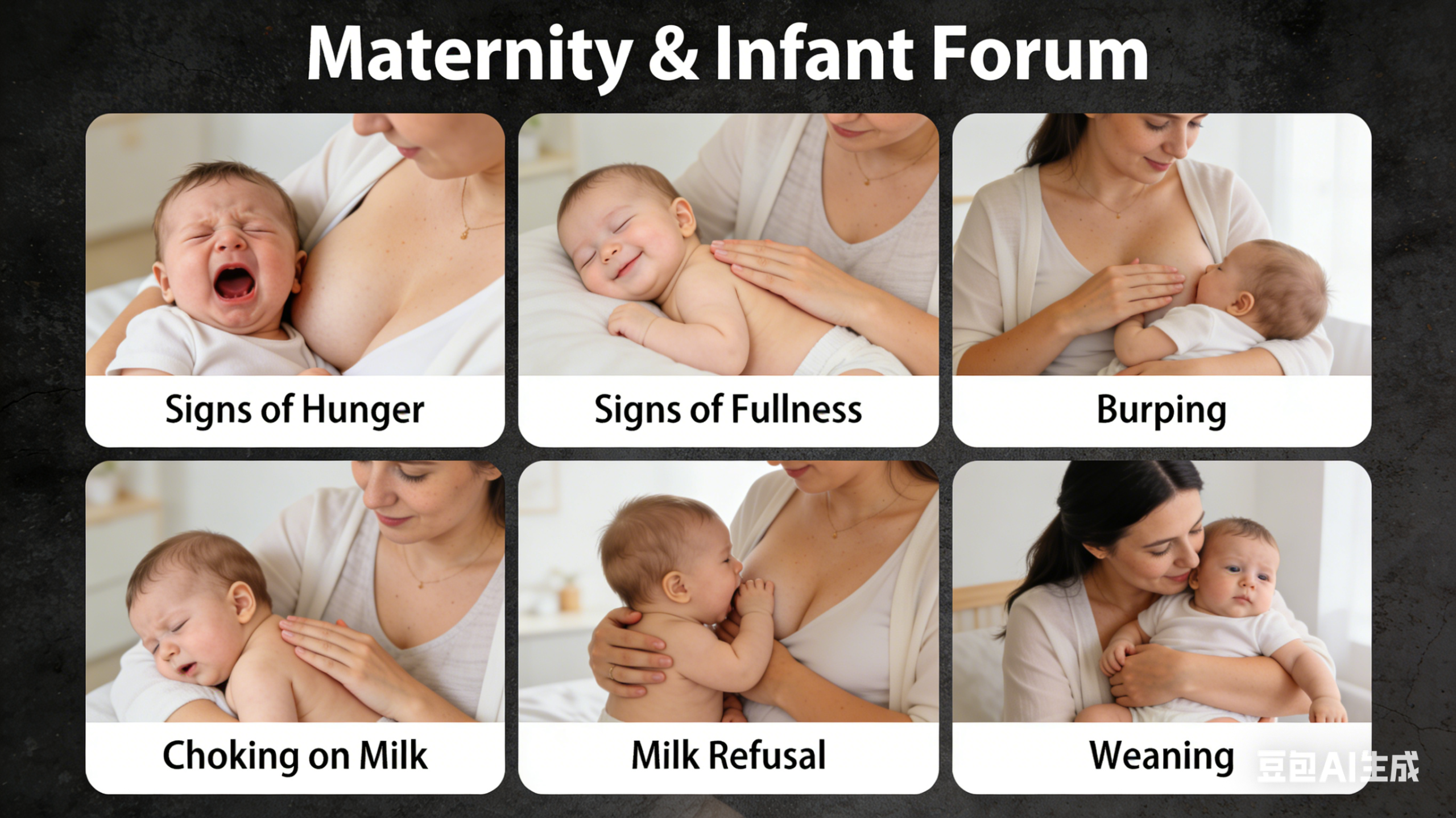
Hunger cues:
– Early: Rooting, sucking on fists, lip smacking
– Late: Crying (harder to latch)
Breastfeeding:
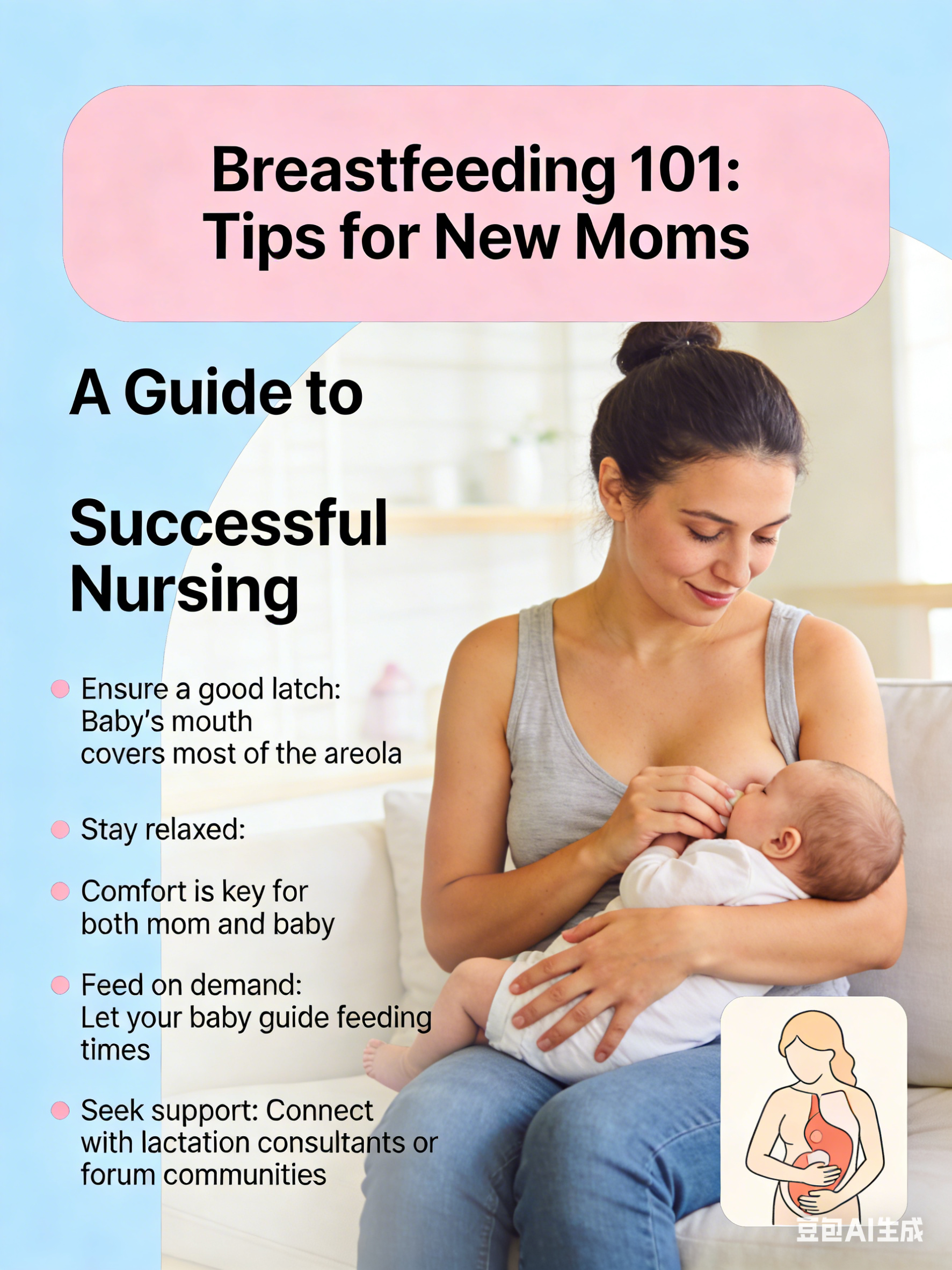
– Aim for 8-12 feeds in 24 hours.
– Ensure good latch: baby’s mouth wide, lower lip turned out, chin touching breast, more areola visible above than below.
– Feed on demand, alternating breasts.
– Seek help early if latch is painful or baby not gaining weight.
Formula feeding:
– Follow manufacturer’s instructions exactly.
– Use freshly boiled water cooled to 70°C to make up powder formula.
– Never reheat or reuse unfinished feeds.
– Sterilise bottles and teats until at least 12 months.
Vitamin supplements (UK guidance):
– All breastfed babies: Vitamin D drops (8.5-10mcg daily) from birth.
– Formula-fed babies: Vitamin D supplements if having less than 500ml formula daily.
7. Skin Care
Newborn skin is delicate – gentle care is essential.
| Common Condition | Management |
|---|---|
| Cradle cap (seborrhoeic dermatitis) | Gentle washing, soft brushing, mild emollients; usually resolves by 6-12 months |
| Baby acne | Leave alone – resolves spontaneously |
| Erythema toxicum | Red blotches with small white/yellow bumps; harmless, resolves by 2 weeks |
| Dry skin | Fragrance-free moisturiser; avoid harsh soaps |
| Milia | Tiny white spots on face; harmless, resolves on own |
When to seek help:
– Widespread rash with fever
– Blisters or pustules
– Baby unwell or lethargic
8. Temperature Taking
Normal newborn temperature:** 36.5°C – 37.5°C .
Methods:
– Axillary (armpit): Most common for home use.
– Tympanic (ear): Accurate if positioned correctly; not recommended under 6 months.
– Rectal: Most accurate but invasive; usually only in hospital.
– Temporal (forehead): Convenient but can be less accurate.
When to seek help:
– Temperature >38°C (urgent review needed in babies under 3 months)
– Temperature <36°C
– Baby feels unusually hot or cold with behaviour change
9. Nail Care
Newborn nails grow quickly and can be sharp.
– Use baby nail scissors or emery board.
– Best time to cut: when baby is asleep or drowsy.
– Cut straight across, not too short.
– If you accidentally cut skin, apply gentle pressure with clean cotton wool; monitor for infection.
Alternative: Gently file nails with soft emery board instead of cutting.
10. Bowel Movements
Newborn stools vary widely and change over time.
| Age/Feeding Type | Normal Appearance |
|---|---|
| First 24-48 hours | Meconium: dark green/black, sticky, tar-like |
| Days 3-4 | Transitional stools: greenish-brown |
| Breastfed | Mustard yellow, seedy, loose; may pass after every feed |
| Formula-fed | Tan/yellow/brown, pasty consistency; less frequent |
Frequency:
– Can range from several per day to one every few days.
– Breastfed babies may go several days without a stool – normal if passing soft stool when it comes.
When to seek help:
– No meconium in first 48 hours
– Pale, chalky, or white stools
– Blood in stool
– Constipation: hard, pellet-like stools, distress
11. Jaundice
Definition: Yellow discolouration of skin and eyes caused by elevated bilirubin.
Physiological jaundice:
– Appears day 2-4
– Peaks day 5-7
– Resolves by 2 weeks (breastfed babies may take longer)
When to seek urgent review:
– Jaundice appearing in first 24 hours
– Yellow palms and soles
– Baby lethargic, not feeding well
– Dark urine (should be colourless) or pale stools
– Not improving by 2 weeks
Management: Ensure adequate feeding; phototherapy may be needed if levels high.
12. Baby Blues vs Postnatal Depression
| Baby Blues | Postnatal Depression |
|---|---|
| Affects 80% of new mothers | Affects 10-15% |
| Onset day 3-5 | Can start any time in first year |
| Lasts days to 2 weeks | Lasts >2 weeks |
| Tearfulness, mood swings | Persistent low mood, loss of interest |
| Resolves spontaneously | Requires professional help |
Seek help if:
– Symptoms persist beyond 2 weeks
– Unable to cope with daily tasks
– Thoughts of harming self or baby
– Difficulty bonding with baby
13. When to Seek Medical Help
Contact your GP, health visitor, or 111 urgently if your baby:
– Has a temperature ≥38°C (under 3 months) or ≥39°C (3-6 months)
– Is lethargic, difficult to wake, or unusually floppy
– Has poor feeding (less than half usual feeds in 24 hours)
– Has fewer wet nappies (less than 4 in 24 hours after day 5)
– Has difficulty breathing (grunting, nasal flaring, chest retractions)
– Has persistent vomiting (green or forceful)
– Has a fit (seizure)
– Has umbilical cord redness spreading or pus
– Has jaundice spreading to palms/soles
In emergency (call 999):
– Not breathing
– Unresponsive
– Severe difficulty breathing
– Blue lips or face
Resources:
– The Lullaby Trust (safe sleep): www.lullabytrust.org.uk
– NCT (breastfeeding support): www.nct.org.uk
– Association of Breastfeeding Mothers: www.abm.me.uk
– NHS Start for Life: www.nhs.uk/start-for-life
*References available upon request.*
a.本站所有文章,如无特殊说明或标注,均为本站原创发布。
b.任何个人或组织,在未征得本站同意时,禁止复制、盗用、采集、发布本站内容到任何网站、书籍等各类媒体平台。
c.如若本站内容侵犯了原著者的合法权益,可联系我们进行处理。









No comments yet