



Preparing for Childbirth (Part 5): A Professional Guide to Labour, Delivery, and Complications
This final instalment in our childbirth preparation series covers essential topics ranging from normal vaginal birth to critical obstetric emergencies. Understanding these concepts empowers expectant parents to make informed decisions and recognise when to seek urgent care.
*Disclaimer: This information is for educational purposes only and does not replace professional medical advice. Always consult your midwife or obstetrician for guidance specific to your pregnancy.*
1. Vaginal Birth (Normal Delivery)
Definition: Spontaneous delivery of a fetus through the birth canal at term (37-42 weeks gestation), without surgical assistance.
Incidence: Approximately 60-70% of births in the UK are spontaneous vaginal deliveries .
Indications for vaginal birth: Most pregnancies with cephalic (head-down) presentation, normal fetal heart rate patterns, and adequate maternal pelvis.
Contraindications: Placenta praevia, cord prolapse, active genital herpes, certain fetal malpresentations, previous uterine rupture.
Benefits: Shorter maternal hospital stay, faster recovery, reduced risk of respiratory complications for baby, earlier breastfeeding initiation.
2. Second Vaginal Birth (VBAC After Previous Vaginal Birth)
Definition: Vaginal delivery in a woman who has previously given birth vaginally, including those with a prior caesarean section (VBAC).
Success rates: Women with prior successful VBAC have a high likelihood of achieving another successful VBAC. Success rates increase with the number of prior VBACs:
| Prior VBAC History | Success Rate |
|---|---|
| No prior VBAC | 73.2% |
| 1 prior VBAC | 92.3% |
| 2+ prior VBACs | 94-97% |
Benefits: Shorter hospitalisation for mother and neonate, reduced risk of blood transfusion compared to those without VBAC history .
Considerations: Trial of labour after caesarean (TOLAC) requires careful counselling regarding uterine rupture risk (0.5-1%).
3. Common Questions About Vaginal Birth
Q: How long does vaginal birth typically last?
A: Total labour duration varies widely. First-time mothers average 8-18 hours from onset of active labour to delivery; subsequent labours are often shorter (5-12 hours).
Q: Can I eat and drink during labour?
A: For low-risk women, light snacks and clear fluids are generally permitted in early labour. During active labour, many units restrict solid food due to aspiration risk if general anaesthesia becomes necessary .
Q: What pain relief options are available?
A: Options include non-pharmacological (breathing techniques, water immersion, TENS), entonox (gas and air), opioid injections, and epidural analgesia .
Q: When should I go to the hospital?
A: Contact your midwife when contractions are regular (every 5 minutes for at least 1 hour), waters break, or you have concerns about reduced fetal movements.
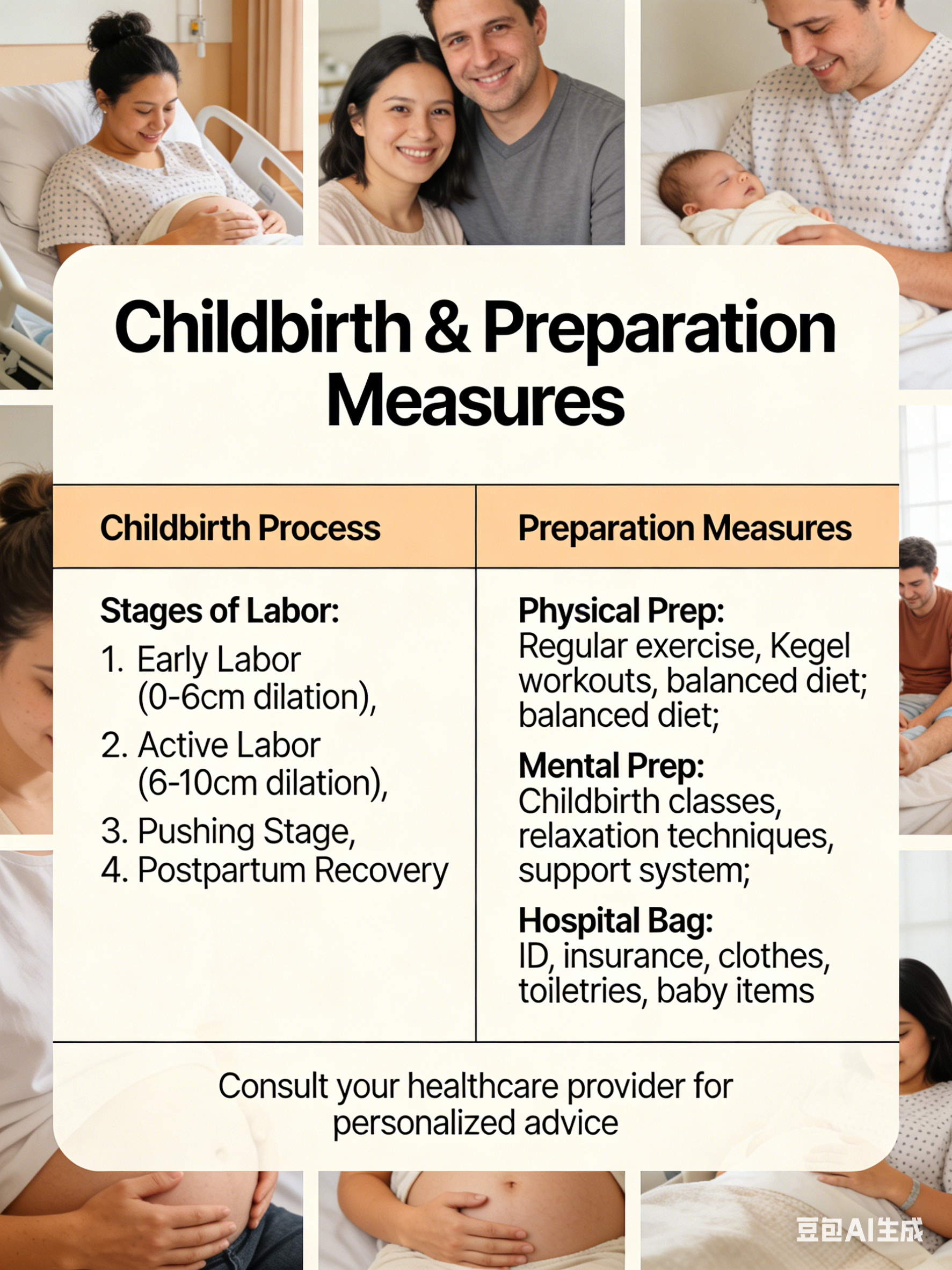
4. Stages of Labour
| Stage | Phase | Description | Duration (First Birth) |
|---|---|---|---|
| First stage | Latent phase | Onset of regular contractions to 4 cm cervical dilation | 6-12 hours (variable) |
| Active phase | 4 cm to 10 cm dilation, more rapid progress | 4-8 hours | |
| Second stage | Passive descent | Full dilation to urge to push | Up to 2 hours with epidural |
| Active pushing | Pushing to delivery of baby | 1-3 hours | |
| Third stage | Placental delivery | Delivery of placenta and membranes | 5-30 minutes |
Active management of third stage: Prophylactic uterotonic (oxytocin) administered, controlled cord traction, reducing PPH risk by 60% .
5. Emergency Caesarean Section (Unplanned C-Section)
Definition: Caesarean delivery performed urgently due to maternal or fetal complications during labour.
Indications:
– Fetal distress: Abnormal fetal heart rate patterns unresponsive to resuscitation
– Failure to progress: Arrest of labour despite adequate contractions
– Cord prolapse: Umbilical cord presenting before fetus
– Maternal compromise: Haemorrhage, severe pre-eclampsia, cardiac events
Decision-to-delivery interval: For category 1 (immediate threat to life) caesarean, target is within 30 minutes.
Incidence: Approximately 15-25% of labours result in emergency caesarean, depending on population and setting .
6. Malpresentation (Abnormal Fetal Position)
Definition: Any fetal presentation other than vertex (head-down) with occiput anterior position.
Types and incidence at term :
– Breech: Buttocks or feet presenting first – 3-4% of term deliveries
– Face presentation: <0.2%
– Brow presentation: <0.1%
– Transverse lie: <0.3%
– Compound presentation: Extremity alongside presenting part – rare
External Cephalic Version (ECV): Manipulation through abdominal wall to rotate breech to cephalic presentation. Typically performed around 37 weeks. Success rate 50-60% with appropriate patient selection .
Risk factors for breech :
– Uterine abnormalities
– Placenta praevia
– Polyhydramnios/oligohydramnios
– Multiple gestation
– Previous breech delivery
Management: Options include ECV, planned vaginal breech delivery (selected cases), or elective caesarean section.
7. Late Postpartum Haemorrhage (Secondary PPH)
Definition: Excessive bleeding occurring between 24 hours and 12 weeks postpartum.
Incidence: Approximately 1% of deliveries.
Causes:
– Retained products of conception (most common)
– Endometritis (uterine infection)
– Subinvolution of placental site
– Coagulation disorders
Clinical features:
– Bleeding heavier than normal lochia
– Passage of clots
– Abdominal pain or tenderness
– Fever (if infection present)
Management:
– Ultrasound to assess for retained tissue
– Antibiotics for infection
– Surgical evacuation if retained products confirmed
– Uterotonics if uterine atony persists
8. Epidural Analgesia (Labour Pain Relief)
Definition: Regional anaesthesia technique involving insertion of a catheter into the epidural space to deliver continuous local anaesthetic and opioid medication.
Procedure:
– Inserted by anaesthetist during labour
– Takes 15-20 minutes to place, 20-30 minutes for full effect
– Catheter allows top-up doses or patient-controlled analgesia
Benefits:
– Provides excellent pain relief (rated 0-1 on 0-10 pain scale)
– Allows mother to rest during prolonged labour
– Can be extended for caesarean section if needed
Considerations:
– May prolong second stage of labour
– Increases likelihood of instrumental delivery (forceps/vacuum)
– Requires continuous fetal monitoring
– Mobile epidurals allow some leg movement
Side effects: Hypotension, urinary retention, itching, fever, rare neurological complications.
9. Amniotic Fluid Embolism (AFE)
Definition: Rare but catastrophic obstetric emergency characterised by sudden entry of amniotic fluid or fetal debris into maternal circulation, triggering cardiopulmonary collapse .
Incidence: Approximately 1 in 40,000 deliveries; significant contributor to maternal mortality .
Pathophysiology: Immune-mediated anaphylactoid reaction and mechanical vascular obstruction leading to acute hypoxia, hypotension, and disseminated intravascular coagulation (DIC) .
Clinical presentation (classic triad):
– Hypoxia: Sudden respiratory distress, cyanosis
– Hypotension: Cardiovascular collapse, shock
– Coagulopathy: Severe bleeding, DIC
Risk factors : Advanced maternal age, placental abnormalities, induction of labour, operative delivery, polyhydramnios.
Diagnosis: Clinical diagnosis – no single confirmatory biomarker exists .
Management:
– Immediate resuscitation (airway, breathing, circulation)
– Haemodynamic support with fluids and vasopressors
– Aggressive coagulopathy correction (transfusion, tranexamic acid)
– Multidisciplinary team response
Prognosis: High mortality rate; survivors may have neurological sequelae.
10. Preterm Birth
Definition: Birth before 37 completed weeks of gestation.
Classification:
– Extremely preterm: <28 weeks
– Very preterm: 28-32 weeks
– Moderate to late preterm: 32-37 weeks
Incidence: Affects approximately 8% of births in the UK.
Risk factors:
– Previous preterm birth
– Multiple pregnancy
– Uterine or cervical abnormalities
– Infection (chorioamnionitis)
– Maternal medical conditions (hypertension, diabetes)
– Smoking, substance misuse
Preterm Prelabour Rupture of Membranes (PPROM): Complicates up to 3% of pregnancies and is associated with 30-40% of preterm births .
Management of PPROM:
– Antibiotics (erythromycin) for 10 days or until labour
– Antenatal corticosteroids up to 34+6 weeks gestation
– Magnesium sulfate for neuroprotection
– Expectant management until 37 weeks if no contraindications
Neonatal risks: Respiratory distress syndrome, intraventricular haemorrhage, necrotising enterocolitis, infection, long-term neurodevelopmental issues.
11. Uterine Rupture
Definition: Complete or partial disruption of all uterine layers (including serosa), or disruption of uterine scar with communication to peritoneal cavity.
Incidence:
– Women with intact uterus: <0.01%
– Women with prior caesarean section attempting VBAC: 0.5-1%
– Women with prior classical caesarean incision: 4-9%
Risk factors:
– Previous uterine surgery (caesarean, myomectomy)
– Induction/augmentation of labour with prostaglandins or oxytocin
– Multiple prior caesareans
– Trauma (rare)
– Grand multiparity
Clinical features:
– Sudden onset severe abdominal pain (may diminish between contractions)
– Abnormal fetal heart rate pattern (late decelerations, bradycardia)
– Vaginal bleeding (may be minimal)
– Loss of station of presenting part
– Maternal tachycardia, hypotension, shock
Management:
– Emergency laparotomy
– Delivery of fetus
– Uterine repair or hysterectomy depending on extent
– Massive transfusion protocol activation
– Multidisciplinary team response
Prognosis: Significant maternal and fetal morbidity/mortality; prompt recognition and intervention critical.
12. Term Pregnancy
Definition: Pregnancy between 37 completed weeks and 42 completed weeks gestation.
Classification (based on ACOG definitions):
| Term Category | Gestational Age |
|---|---|
| Early term | 37 0/7 – 38 6/7 weeks |
| Full term | 39 0/7 – 40 6/7 weeks |
| Late term | 41 0/7 – 41 6/7 weeks |
| Postterm | ≥42 0/7 weeks |
Significance:
– Elective delivery before 39 weeks not recommended without medical indication due to neonatal respiratory and other risks
– Postterm pregnancy (≥42 weeks) associated with increased risks of meconium, macrosomia, stillbirth, and operative delivery
– Induction of labour recommended by 41-42 weeks
Summary Table: Key Definitions
| Condition | Definition |
|---|---|
| Term | 37-42 weeks gestation |
| Preterm | <37 weeks gestation |
| Postterm | ≥42 weeks gestation |
| PPH | ≥500 ml (vaginal) or ≥1000 ml (caesarean) within 24 hours |
| AFE | Acute cardiopulmonary collapse from amniotic fluid entry into maternal circulation |
| Malpresentation | Non-cephalic fetal presentation at term |
When to seek urgent care:
– Heavy vaginal bleeding (soaking pad every 30 minutes)
– Severe abdominal pain not relieved by analgesia
– Sudden shortness of breath or chest pain
– Fever >38°C with chills
– Reduced fetal movements
– Water breaking with green/brown fluid
– Signs of labour before 37 weeks
**References available upon request.**
a.本站所有文章,如无特殊说明或标注,均为本站原创发布。
b.任何个人或组织,在未征得本站同意时,禁止复制、盗用、采集、发布本站内容到任何网站、书籍等各类媒体平台。
c.如若本站内容侵犯了原著者的合法权益,可联系我们进行处理。








No comments yet