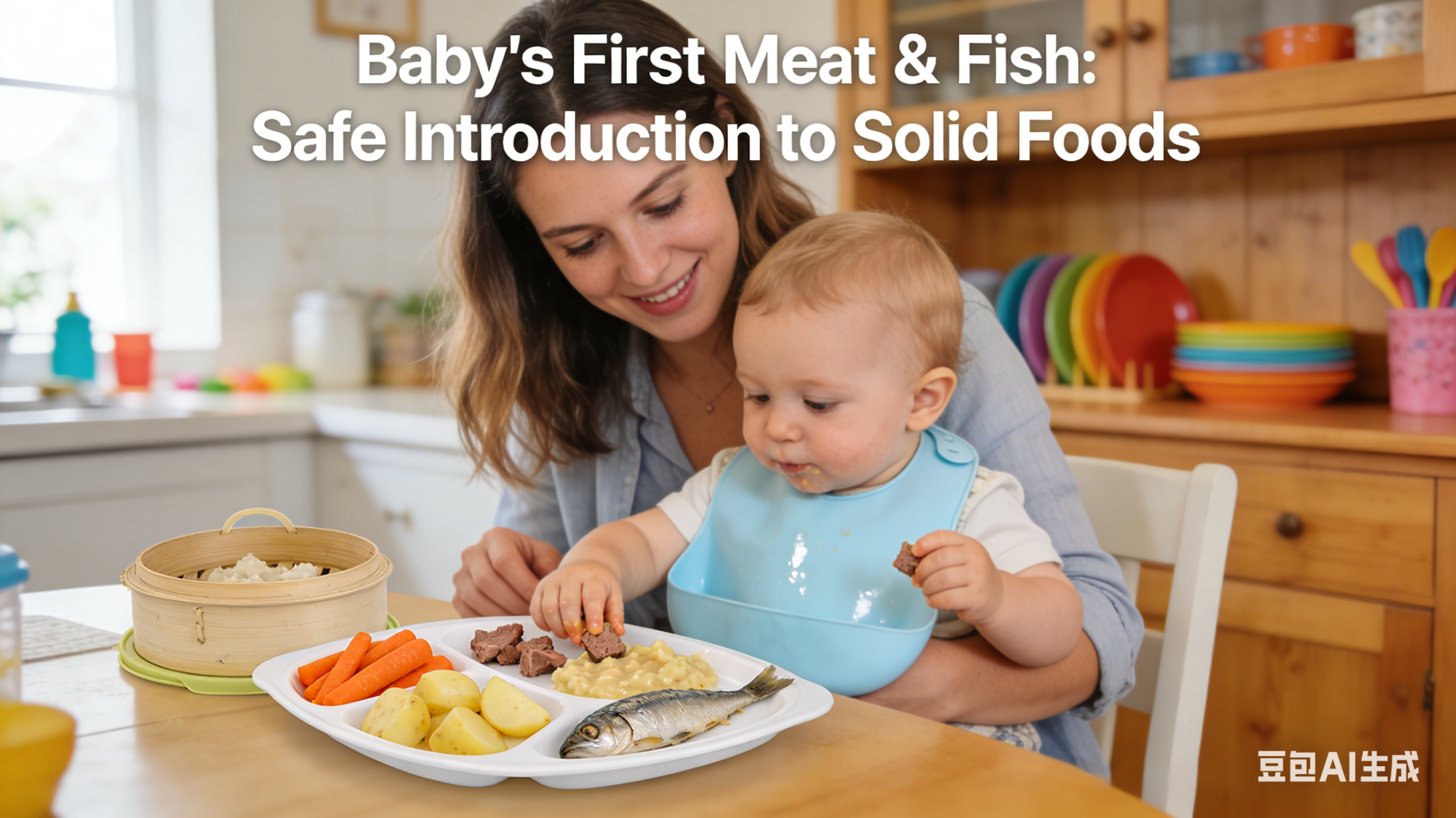




Baby Complementary Feeding: A Professional Guide to Introducing Meat and Fish
Once your baby is ready for solid foods, introducing meat and fish provides essential nutrients including iron, protein, and omega-3 fatty acids. This guide provides evidence-based information on when and how to introduce these foods safely, which types to choose, and important safety considerations.
*Disclaimer: This information is for educational purposes only and does not replace professional medical advice. Always consult your health visitor, GP, or paediatrician for concerns about your baby.*
Part 1: Introducing Meat to Your Baby
When Can Babies Start Eating Meat?
UK guidance recommends that a variety of solid foods should be introduced from around 6 months of age, alongside breastmilk or first infant formula, and that foods offered should contain iron—making meat an excellent early choice. After 6 months, babies can eat meat (including chicken, pork, beef and lamb) to obtain iron.
Meat is particularly valuable as one of the first foods because it provides haem iron, which is more easily absorbed by the body than iron from plant sources.
How to Prepare Meat for Your Baby
| Stage | Texture | Method |
|---|---|---|
| 6-7 months | Smooth puree | Steam or boil meat until thoroughly cooked, then blend to a smooth consistency |
| 7-9 months | Mashed or minced | Shorten blending time to introduce texture; mix with vegetables and a small amount (½-1 teaspoon) of vegetable oil |
| 9-12 months | Finely chopped | Soft, small pieces that baby can pick up as finger foods |
| 12+ months | Small bite-sized pieces | Baby can manage soft, well-cooked meat pieces |
Step-by-step meat puree preparation (Hong Kong FHS method):
1. Wash a piece of meat and chop it into fine strips and lumps on a cutting board for raw food
2. Add some water to the raw meat lumps and stir
3. Steam for 5-8 minutes until thoroughly cooked
4. Transfer cooked meat lumps with meat juice into a blender and blend to desired consistency
5. Add drinking water to adjust texture as needed
To serve: Add meat puree to congee with vegetables, mix into infant cereal, or feed alone as a standalone puree.
Meat Safety Tips
| Safety Rule | Why It Matters |
|---|---|
| Trim all visible fat | Fat is difficult for babies to digest |
| Cook thoroughly until no pink remains | Eliminates harmful bacteria |
| Never add salt or stock cubes | Babies’ kidneys cannot handle excess sodium |
| Avoid processed meats (bacon, sausage, ham, salami) | High in salt and preservatives |
| Store raw meat at bottom of fridge | Prevents drips onto other foods |
Benefits of Meat for Babies
– Iron: Essential for brain development and red blood cell production. Iron stores from birth are depleted by 6 months
– Protein: Supports growth and tissue repair
– Zinc: Important for immune function and growth
– B vitamins: Including B12 (not found in plant foods)
Part 2: Introducing Fish to Your Baby
When Can Babies Start Eating Fish?
Guidelines in the UK recommend that fish can be offered to babies from 6 months of age. The NHS suggests that once baby is comfortable with their first solid foods, mashed fish (without any bones) is a good food option to offer. This includes both white fish (cod, haddock) and oily fish (salmon, trout, mackerel).
Fish is considered an allergen, so it should be offered in line with guidance on introducing allergens—in small amounts at first, and ensure fish is the ONLY new food offered that day the first time it’s given.
Types of Fish for Babies
| Type | Examples | Key Nutrients | Weekly Limit |
|---|---|---|---|
| White fish | Cod, haddock, pollock, tilapia, sea bass, plaice, hake, sole | Protein, iodine, iron, low-fat | No limit (within balanced diet) |
| Oily fish | Salmon, mackerel, sardines, trout, herring | High in omega-3 DHA, vitamin D | Girls: max 2 portions/week |
| Shellfish | Prawns, crab, mussels, scallops | Protein, zinc, selenium | Boys: max 4 portions/week |
Why the limit on oily fish for girls? Pollutants like dioxins and PCBs can build up in the body and may harm an unborn baby during a future pregnancy. The limit applies to all girls to protect their reproductive years.
Which Fish Are NOT Safe for Babies?
Avoid feeding fish high in mercury to young children. These fish include:
| Fish to Avoid | Reason |
|---|---|
| Shark | High mercury |
| Swordfish | High mercury |
| Marlin | High mercury |
| King mackerel | High mercury |
| Tilefish (Gulf of Mexico) | High mercury |
| Orange roughy | High mercury |
| Bigeye tuna | High mercury |
| Raw shellfish | Risk of food poisoning |
The CDC advises that mercury can harm the brain and nervous system if a person is exposed to too much over time, and these large predatory fish contain the highest levels[reference:12].
Safe Fish Choices (Low Mercury)
The FDA/EPA divide fish into three lists. For children, the **Best Choices** list is recommended:
| Best Choices (Lowest Mercury) | Good Choices (Higher Mercury – Limit) |
|---|---|
| Salmon | Halibut |
| Canned light tuna | Canned white/albacore tuna |
| Trout | |
| Shrimp | |
| Cod | |
| Haddock | |
| Pollock | |
| Sardines | |
| Tilapia |
For children ages 1-11, 1-2 servings of fish per week from the Best Choices list is recommended.
How to Prepare Fish for Your Baby
1. Cook thoroughly until fish flakes easily and is opaque all the way through
2. Remove all bones carefully – run fingers through cooked fish to feel for any small bones
3. Remove skin before serving
4. Serve mashed, flaked, or blended with vegetables or potato
5. Avoid adding salt – babies should have less than 1g of salt per day
Preparation method: Remove bones and skin, steam or bake until fully cooked, then mash or flake. You can mix with cooked vegetables, mashed potato, or infant cereal.
Tinned Fish for Babies
Tinned fish (salmon, tuna, sardines) can be a convenient option. However:
– Choose fish in **spring water** (not brine or oil)
– Check labels for **added salt**
– Choose **light tuna** over albacore/white tuna (lower mercury)
– Limit tuna to **once or twice a week** as it can contain more mercury than other fish
Part 3: Allergy Considerations
Both meat and fish can trigger allergic reactions, though fish and shellfish are among the top 14 major allergens in the UK.
Signs of a Food Allergy in Babies
| System | Symptoms |
|---|---|
| Skin | Redness or rash around mouth or face, hives, swelling of lips or face |
| Digestive | Vomiting, diarrhoea, abdominal pain |
| Respiratory | Coughing, wheezing, noisy breathing |
| Behavioural | Sudden fussiness or irritability, refusal to eat |
How to Introduce Fish Safely
1. Introduce fish in the **morning** so you can monitor for reactions throughout the day
2. Offer fish as the **only new food** that day
3. Start with a **small amount** (e.g., half a teaspoon)
4. If no reaction occurs, gradually increase the amount over subsequent days
5. If there is a family history of allergies, speak to your GP before introducing fish
**Emergency signs:** If your baby has trouble breathing, call 999 immediately.
Part 4: Storage and Safety
Storing Meat and Fish
| Item | Refrigerator | Freezer |
|---|---|---|
| Fresh meat | Use within 2 days of purchase | Up to 3 months |
| Fresh fish | Use within 1-2 days | Up to 3 months |
| Cooked baby food with meat/fish | 24 hours | Up to 1 month |
| Cooked baby food with fruit/veg | 48 hours | Up to 1 month |
Key safety points:
– Keep raw meat and fish in a container at the bottom of the fridge to avoid dripping onto other food[reference:22]
– Cooked baby food should be cooled within 1-2 hours, then refrigerated or frozen[reference:23]
– Never reheat food more than once[reference:24]
– Discard any half-eaten portions – never save leftovers from baby’s bowl[reference:25]
Reheating Baby Food
1. Defrost frozen food thoroughly in the fridge overnight (never at room temperature)[reference:26]
2. Reheat until **steaming hot** all the way through
3. Stir well to eliminate hot spots (especially important when using a microwave)
4. Test temperature on the inside of your wrist before serving
5. Never reheat food more than once
Summary Table: Meat and Fish at a Glance
| Topic | Key Messages |
|---|---|
| When to start | From 6 months, alongside other solid foods |
| Meat types | Chicken, pork, beef, lamb – well-cooked, pureed initially |
| Fish types | White fish (cod, haddock) and oily fish (salmon, trout) – boneless, cooked |
| Fish to avoid | Shark, swordfish, marlin, king mackerel, tilefish (high mercury) |
| Oily fish limit | Girls: 2 portions/week; Boys: 4 portions/week |
| Preparation | Cook thoroughly, remove bones/skin, puree or mash, no added salt |
| Allergy introduction | Introduce one at a time, in small amounts, in the morning |
| Storage | Cooked baby food with meat/fish: 24 hours in fridge, 1 month in freezer |
**Key Resources:**
– NHS Start for Life: www.nhs.uk/start-for-life
– First Steps Nutrition Trust: www.firststepsnutrition.org
– British Dietetic Association: www.bda.uk.com
– Allergy UK: www.allergyuk.org
*References available upon request. Key sources: NICE guideline 2025, Hong Kong FHS, CDC, FDA/EPA, SR Nutrition, Netmums, NHS Best Start in Life.*
a.本站所有文章,如无特殊说明或标注,均为本站原创发布。
b.任何个人或组织,在未征得本站同意时,禁止复制、盗用、采集、发布本站内容到任何网站、书籍等各类媒体平台。
c.如若本站内容侵犯了原著者的合法权益,可联系我们进行处理。







No comments yet