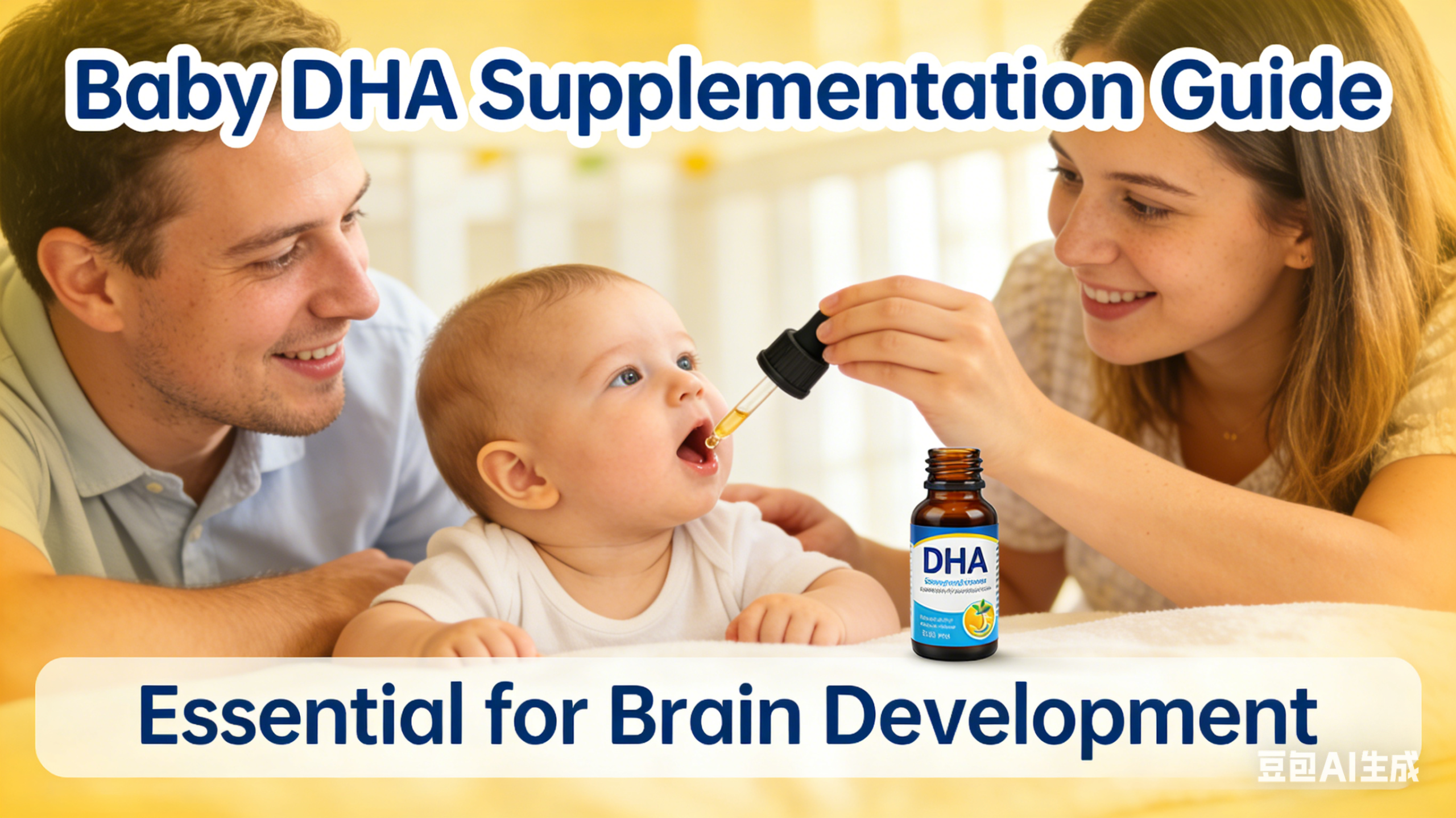




A Complete Guide to DHA Supplementation
DHA (docosahexaenoic acid) is one of the most talked-about nutrients in early childhood development. As a key structural component of the brain and retina, ensuring adequate intake during the critical early years is essential. This guide provides evidence-based information on how to incorporate DHA into your baby’s diet, when supplementation is necessary, and how to choose between fish oil and algae oil.
*Disclaimer: This information is for educational purposes only and does not replace professional medical advice. Always consult your health visitor, GP, or paediatrician for concerns about your baby.*
1. Why DHA Matters for Babies
DHA (docosahexaenoic acid) is an omega-3 long-chain polyunsaturated fatty acid that is critical for neurodevelopment in infants. It is the major fatty acid in the brain and is transferred from the mother to the fetus during pregnancy, primarily during the last trimester .
Key functions:
– Brain development: DHA makes up 20-30% of the brain’s total fatty acids, directly influencing synapse formation and signal transmission .
– Vision: DHA is highly concentrated in the retina and essential for visual development .
– Structural role: DHA is an important component of neural cellular membranes .
Critical window: The most dramatic neurodevelopmental changes occur prenatally and early postnatally . Ensuring adequate DHA during this period supports optimal brain maturation.
2. DHA Requirements by Age
| Age Group | Recommended DHA Intake | Notes |
|---|---|---|
| Infants 0-6 months | 100 mg/day | 0.1 g/day |
| Infants 7-12 months | 100 mg/day | 0.1 g/day |
| Children 1-3 years | 100 mg/day | 0.1 g/day |
| Breastfeeding mothers | ≥200 mg/day | To ensure adequate DHA in breast milk |
| Preterm infants | 55-60 mg/kg/day until 40 weeks | Some sources recommend 100-200 mg/day |
International guidelines:
– ESPHAGN (European Society for Paediatric Gastroenterology, Hepatology, and Nutrition): For preterm infants, DHA intake of 30-65 mg/kg/day (approximately 0.5% to 1% of total fatty acids) is recommended, assuming sufficient intake of arachidonic acid (ARA) is provided .
– Formula standards: DHA content in infant formula should be ≥0.3% of total fatty acids, with EPA ≤0.1% (Chinese national standard GB10765-2021) .
3. How to Get DHA: A Stage-by-Stage Guide
0-6 Months: Breastfeeding and Formula
Breastfed babies:
– Breast milk naturally contains DHA, with concentrations varying based on maternal diet .
– If the mother consumes adequate DHA (≥200 mg daily), breastfed babies typically receive sufficient DHA without needing supplements .
– Breast milk DHA levels are influenced by maternal intake—mothers should eat DHA-rich foods or take supplements if needed.
Formula-fed babies:
– Infant formula is fortified with DHA according to regulations .
– Most commercial infant formulas contain DHA .
– Under current standards (GB10765-2021), formula DHA content should be adequate, so **formula-fed babies generally do not need extra DHA supplements** .
6-12 Months: Introducing Solids
At this stage, complementary foods become important DHA sources alongside milk .
DHA-rich first foods:
| Food | Preparation | Frequency |
|---|---|---|
| Salmon | Cooked, flaked, bones removed | 1-2 portions weekly |
| Cod | Cooked, flaked, bones removed | 1-2 portions weekly |
| Trout | Cooked, flaked, bones removed | 1-2 portions weekly |
| Sardines | Canned in water (no salt), mashed | 1-2 portions weekly |
| Egg yolk | Cooked, mashed | Can be offered regularly |
Important: Choose fish that are higher in DHA and lower in mercury—examples include salmon, herring, sardines, and trout . Avoid high-mercury fish such as shark, swordfish, and king mackerel.
1-3 Years: Family Foods
– Offer 2-3 portions of fish weekly, including one portion of oily fish .
– Continue to prioritise whole food sources over supplements.
– If dietary intake is adequate, supplements are unnecessary.
4. When Is Supplementation Necessary?
General principle: For most healthy, full-term infants with adequate maternal diet or appropriate formula, DHA supplements are not needed .
Indications for DHA supplementation:
| Indication | Details | Recommended Dose |
|---|---|---|
| Preterm infants | Miss out on third-trimester DHA transfer; higher requirements | 100-200 mg/day or 55-60 mg/kg/day |
| Breastfeeding mothers with low DHA intake | If maternal diet lacks DHA-rich foods | Mother should supplement 200 mg/day |
| Infants with fish allergy | Cannot consume DHA-rich fish | 100 mg/day |
| Dietary restrictions | Vegan/vegetarian families not consuming DHA-fortified foods | 100 mg/day |
| Confirmed developmental concerns | Under medical guidance | As prescribed |
Important considerations:
– For preterm infants, **ARA (arachidonic acid) should be given alongside DHA** . Studies show supplementation with both ARA and DHA improves white matter maturation compared to control treatment .
– ARA is a necessary addition to DHA-containing infant formula, with many international guidelines mandating at least a 1:1 ratio .
When NOT to supplement:
– Healthy term infants receiving adequate breast milk (with maternal DHA intake) or standard formula
– Children already consuming 1-2 portions of oily fish weekly
5. Fish Oil vs Algae Oil: A Detailed Comparison
When supplementation is needed, parents face the choice between fish oil and algae oil. Here is a comprehensive comparison based on current evidence :
| Factor | Fish Oil | Algae Oil |
|---|---|---|
| Source | Fatty fish (salmon, mackerel, anchovies) | Microalgae (Crypthecodinium cohnii, Schizochytrium sp.) |
| DHA/EPA content | Contains both DHA and EPA | Contains DHA only (minimal to no EPA) |
| EPA proportion | Variable; some products have EPA:DHA up to 3:1 | EPA not present (advantage for infants) |
| Contamination risk | Potential for heavy metals, dioxins, PCBs | No marine contaminants; pure source |
| Allergen risk | Contains fish proteins; unsuitable for fish allergy | No allergens; suitable for all, including vegans |
| Taste/odor | Fishy taste and odor; may cause reflux | Neutral taste; no fishy aftertaste |
| Sustainability | Concerns about overfishing | Sustainable, environmentally friendly production |
| Cholesterol | Contains cholesterol | Cholesterol-free |
| Production | Variable quality; depends on fish source | Consistent composition; controlled fermentation |
Expert consensus: For infants and young children, algae oil is the preferred choice.
Why algae oil is preferred for babies:
1. No EPA for infants: EPA is not recommended for children under 2 years . High EPA can interfere with arachidonic acid (ARA) metabolism, affecting growth . Algae oil provides DHA without unwanted EPA.
2. Purity and safety: Algae oil is free from ocean contaminants such as mercury, PCBs, and dioxins that can accumulate in fish .
3. Suitable for allergies: Safe for children with fish or seafood allergies .
4. Better acceptance: No fishy taste means better compliance .
When fish oil might be acceptable:
– If using a low-EPA formula specifically designed for infants (EPA <50 mg per dose)
– Products with IFOS (International Fish Oil Standards)五星 certification ensuring purity
– rTG (reconstituted triglyceride) form for better absorption
However, even high-quality fish oil contains some EPA, making algae oil the safer, more appropriate choice for the 0-3 age group .
6. How to Choose a DHA Supplement
If supplementation is recommended, use these criteria to select a quality product :
Label checklist:
| Criteria | What to Look For |
|---|---|
| DHA source | Algae oil (裂壶藻 or 寇氏隐甲藻) for infants |
| DHA content per dose | 100 mg per serving (not “per 100g”) |
| EPA content | For 0-3 years: EPA <30% of DHA content (ideally none) |
| Purity certifications | IFOS, GOED, or other third-party testing |
| Additives to avoid | Artificial flavours, sucrose, preservatives (苯甲酸钠, 山梨酸钾) |
| Form | Drops for infants; chewable for older toddlers |
| Storage instructions | Check if refrigeration needed; note expiry after opening |
Dosage tips:
– Give with meals (especially fatty foods) to enhance absorption—**omega-3s need dietary fat for optimal uptake** .
– Do not exceed recommended doses; **excessive DHA (>300 mg/day) may suppress immune function** .
– Store according to manufacturer instructions (many oils oxidise quickly).
7. Common Myths and Truths
| Myth | Truth |
|---|---|
| “All babies need DHA supplements” | Most healthy babies get enough DHA from breast milk (with maternal intake) or formula . |
| “Fish oil is better because it’s ‘natural'” | Fish get DHA from algae—algae oil is the original, direct source without contaminants . |
| “Higher DHA means smarter baby” | DHA is essential but not a “IQ booster”. Excess DHA (>300 mg/day) may have negative effects . |
| “Fish liver oil (cod liver oil) is good for DHA” | Fish liver oil contains high vitamin A and minimal DHA; it is not an appropriate DHA source . |
| “EPA is good for babies too” | EPA is not recommended for infants under 2 years and may interfere with growth . |
| “DHA supplements are risk-free” | Side effects include fishy taste, GI discomfort; excessive doses may affect immunity . |
| “All algae oils are the same” | Quality varies; choose established brands with purity testing and appropriate DHA concentration |
8. Special Populations
Preterm Infants
Preterm infants have higher DHA requirements because they miss the third-trimester placental transfer of DHA .
– Recommendation: DHA 100-200 mg/day or 55-60 mg/kg/day until 40 weeks corrected age .
– Must include ARA: Supplementation with ARA and DHA together improves white matter maturation .
– ESPHAGN recommends DHA intake of 30-65 mg/kg/d (approximately 0.5% to 1% of total fatty acids) with sufficient ARA provided .
– Choose preterm-specific formulations (algae oil without EPA) under medical guidance .
Breastfeeding Mothers with Low DHA Intake
– Maternal DHA intake directly affects breast milk DHA levels .
– Recommendation: Mothers should consume **200 mg DHA daily** through diet or supplements .
– If maternal intake is inadequate, infant may not receive sufficient DHA.
Allergic Infants
– Infants with fish allergy **must avoid fish oil** .
– Algae oil is safe and appropriate .
– Start with 1/4 dose and observe for 72 hours for any reaction .
Vegan/Vegetarian Families
– Algae oil is the only suitable DHA source .
– Ensure adequate ARA from other sources (eggs for vegetarians; fortified foods for vegans).
9. Safety and Side Effects
Generally safe: DHA supplements are well-tolerated in recommended doses .
Potential side effects:
– Mild gastrointestinal symptoms (fishy taste, burping, heartburn, nausea)
– Diarrhoea or stomach discomfort
– Headache (rare)
Safety limits: The U.S. Food and Drug Administration recommends consuming **no more than 5 g/day of EPA and DHA combined** from dietary supplements . For infants, this is far above any recommended dose, but **excessive DHA (>300 mg/day) may suppress immune function** .
Drug interactions: High doses of omega-3s may increase bleeding risk when taken with anticoagulant medications . Consult a healthcare provider if your child is on such medications.
10. Practical Summary: DHA at a Glance
| Age | Primary Sources | Supplement Needed? |
|---|---|---|
| 0-6 months (breastfed) | Breast milk (depends on maternal diet) | No, if mother gets ≥200 mg DHA daily |
| 0-6 months (formula-fed) | Standard infant formula | No—formula is fortified |
| 7-12 months | Breast milk/formula + DHA-rich solids (fish, egg) | Only if fish intake inadequate |
| 1-3 years | Family diet including 2 portions fish weekly | Only if dietary intake insufficient |
| Preterm infants | Specialised nutrition | Yes—100-200 mg/day DHA + ARA under medical guidance |
Bottom line: Prioritise dietary sources first. If supplementation is needed (preterm, allergy, dietary restriction), **choose algae oil over fish oil** for purity, safety, and absence of EPA .
**Resources:**
– NHS Start for Life: www.nhs.uk/start-for-life
– First Steps Nutrition Trust: www.firststepsnutrition.org
– British Dietetic Association: www.bda.uk.com
*References available upon request. Key sources: China Nutrition and Health Food Association 2025 , Beijing Children’s Hospital 2025 , NIH Office of Dietary Supplements , ScienceDirect algal oil reviews , ESPHAGN guidelines via PMC .*
a.本站所有文章,如无特殊说明或标注,均为本站原创发布。
b.任何个人或组织,在未征得本站同意时,禁止复制、盗用、采集、发布本站内容到任何网站、书籍等各类媒体平台。
c.如若本站内容侵犯了原著者的合法权益,可联系我们进行处理。







No comments yet