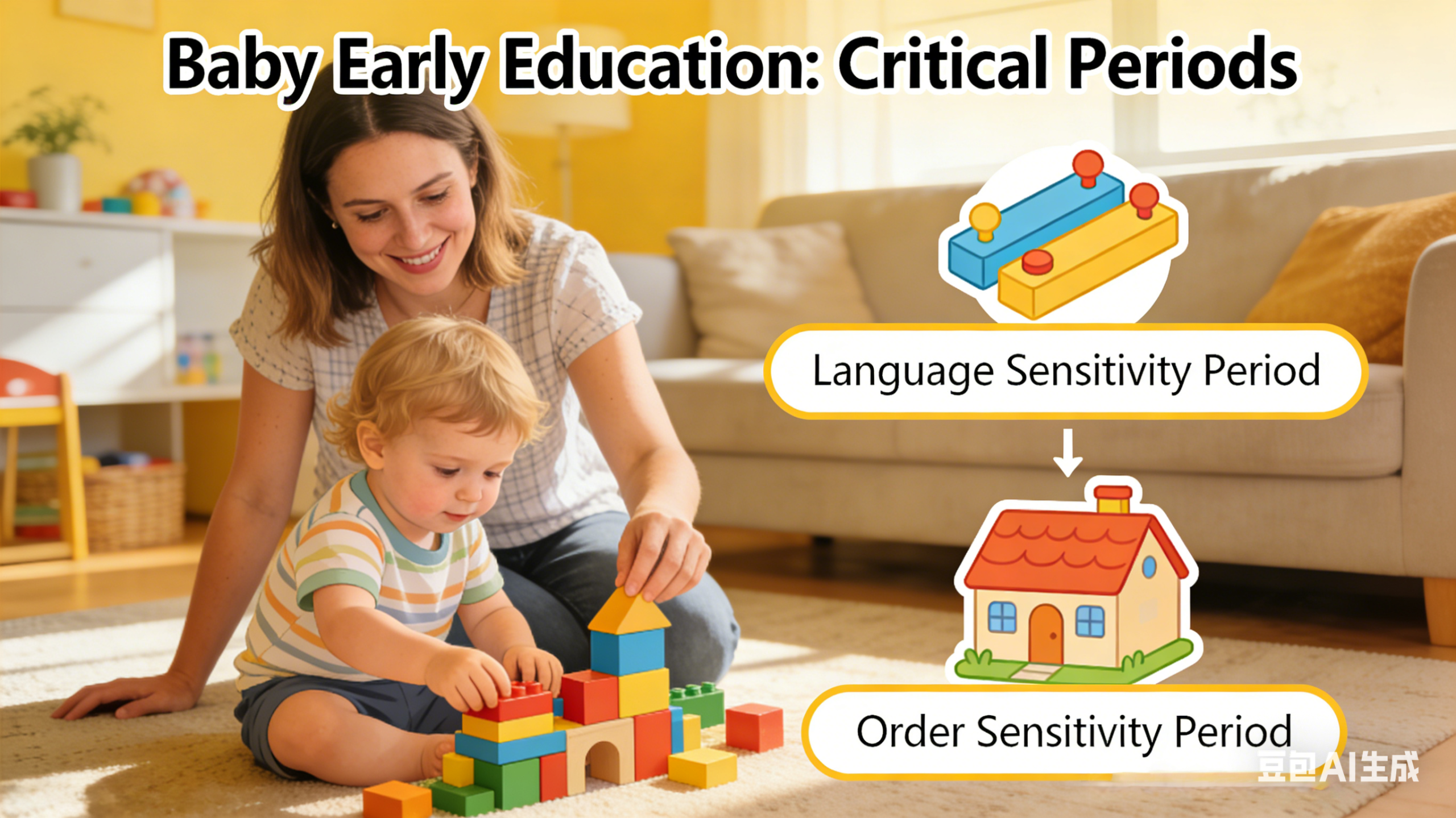




Early Childhood Development: A Professional Guide to Sensitive Periods
Children pass through remarkable windows of opportunity where they are intensely drawn to specific skills, absorbing them with seemingly effortless focus. These “sensitive periods” are a cornerstone of understanding how young children learn. This guide provides evidence-based insights into the key sensitive periods of early childhood and how to support your child through each phase.
*Disclaimer: This information is for educational purposes only and does not replace professional medical or developmental advice. Always consult your health visitor or paediatrician for concerns about your child.*
1. What Are Sensitive Periods?
A sensitive period is a developmental window during which a child shows an intense, spontaneous interest in a specific skill or area of learning. During this time, the brain is particularly receptive to acquiring that skill with ease and joy. After the sensitive period passes, learning the same skill requires more conscious effort.
Key characteristics of sensitive periods:
| Characteristic | Description |
|---|---|
| Intense focus | The child shows sustained, concentrated interest in specific activities |
| Repetition | The child repeats the same activity over and over without tiring |
| Effortless learning | Skills are absorbed naturally, without formal teaching |
| Emotional response | The child may become upset if the drive to engage in the activity is blocked |
| Passing | Once the period ends, the intense interest fades, though the skill remains |
This concept, developed by Maria Montessori and supported by developmental psychology, helps parents understand that these intense phases are not “bad behaviour” but natural developmental drives.
2. Language Sensitive Period
| Aspect | Details |
|---|---|
| Age range | Birth to approximately 6 years |
| Peak intensity | 0–3 years (absorbing language effortlessly) |
What this looks like:
– Newborns distinguish between all speech sounds of any language
– Infants babble, experiment with sounds, and absorb vocabulary from their environment
– Toddlers experience “language explosion” (around 18–24 months), rapidly acquiring new words
– Preschoolers master grammar, sentence structure, and narrative skills
How to support:
– Talk to your child from birth—narrate daily activities
– Read aloud daily
– Respond to babbling and attempts at communication
– Expose child to rich, varied vocabulary
– Avoid “baby talk” once child begins forming words; use clear, correct pronunciation
Key insight: The language-sensitive period is why young children can learn multiple languages effortlessly without accent, while learning a new language later in life requires deliberate study.
3. Sensory Sensitive Period
| Aspect | Details |
|---|---|
| Age range | Birth to approximately 5 years |
| Peak intensity | 2–4 years |
What this looks like:
– Babies explore the world through mouthing, grasping, and looking at high-contrast patterns
– Toddlers touch everything, notice tiny details, and may be fascinated by textures, smells, and sounds
– Children show intense interest in sensory experiences: sand, water, playdough, music, and movement
– They learn by sorting, matching, and discriminating sensory qualities (colours, shapes, sizes, sounds, temperatures)
How to support:
– Provide varied sensory experiences: sand play, water play, natural materials (sticks, leaves, shells)
– Offer materials that allow sorting and matching by colour, shape, size, texture
– Allow safe exploration of taste, smell, and texture (within appropriate limits)
– Spend time in nature where sensory experiences are abundant
4. Movement Sensitive Period
| Aspect | Details |
|---|---|
| Age range | Birth to approximately 4–5 years |
| Peak intensity | 0–2 years (gross motor), 2–4 years (fine motor) |
What this looks like:
– Infants move from reflexive movements to intentional reaching, rolling, sitting, crawling, walking
– Toddlers are in constant motion—climbing, running, carrying objects
– Children develop fine motor control: grasping, pincer grip, using tools (crayons, scissors)
How to support:
– Allow plenty of safe floor time for infants to move freely
– Provide opportunities for climbing, balancing, running, jumping (parks, open spaces)
– Offer materials that support fine motor development: pegs, threading beads, playdough, tongs, child-safe scissors
– Avoid confining children unnecessarily (pushchairs, high chairs, playpens) for extended periods
Key insight: Movement and cognitive development are closely linked. The drive to move is not simply physical—it supports brain development.
5. Order Sensitive Period
| Aspect | Details |
|---|---|
| Age range | Approximately 1–4 years |
| Peak intensity | 2–3 years |
What this looks like:
– Toddlers insist on routines and sameness: the same cup, same bedtime order, same route to nursery
– Children become distressed when things are “out of place”
– They enjoy putting things in order, sorting, and returning items to their proper spots
– Predictable routines provide deep comfort and security
Why it matters: During this period, children are building internal mental order from external order. Predictability helps them make sense of the world.
How to support:
– Maintain consistent daily routines (mealtimes, sleep, transitions)
– Keep belongings in consistent places
– Give warnings before transitions (“Five more minutes, then we tidy up”)
– Acknowledge the child’s need for order rather than labelling it as rigidity
6. Interest in Small Objects (Attention to Detail)
| Aspect | Details |
|---|---|
| Age range | Approximately 1–4 years |
| Peak intensity | 2–3 years |
What this looks like:
– The child notices tiny details adults overlook: a speck on the floor, a small ant, a tiny seed
– Toddlers become absorbed in examining small objects
– They may pick up minuscule items with intense concentration
Why it matters: This sensitivity supports the development of observation skills, attention to detail, and fine motor control.
How to support:
– Follow the child’s interest in nature (small insects, leaves, stones)
– Provide safe small objects for exploration (always supervise for choking hazards with children under 3)
– Avoid rushing the child when they are absorbed in examining something tiny
– Narrate what you observe together: “You found a tiny ladybird. I see its red wings.”
Safety note: For children under 3, ensure small objects are used under supervision to prevent choking.
7. Social Behaviour Sensitive Period
| Aspect | Details |
|---|---|
| Age range | Approximately 2.5–6 years |
| Peak intensity | 3–5 years |
What this looks like:
– Toddlers begin parallel play (playing alongside others) before moving to cooperative play
– Children become fascinated with friendships, group activities, and social rules
– They develop interest in manners, politeness, and what is “fair”
– They learn to take turns, share, and navigate social conflicts
How to support:
– Arrange playdates and social opportunities
– Model polite behaviour and social scripts (“Can I have a turn?” “Thank you”)
– Help children name feelings and resolve conflicts without solving every problem for them
– Provide opportunities for group activities (nursery, classes, playgroups)
8. Writing Sensitive Period
| Aspect | Details |
|---|---|
| Age range | Approximately 3.5–5 years |
| Peak intensity | 4–5 years |
What this looks like:
– Children show interest in making marks that resemble letters
– They may ask how to write letters or write their name
– They enjoy tracing, copying, and forming letters
– The interest often emerges before reading interest
How to support:
– Provide a variety of writing materials: chunky crayons, chalk, pencils, paper
– Allow free mark-making without pressure to form letters correctly
– Write your child’s name on their artwork and point out letters
– Sand trays, salt trays, and chalkboards offer sensory writing experiences
– Do not force formal writing; follow the child’s readiness
9. Reading Sensitive Period
| Aspect | Details |
|---|---|
| Age range | Approximately 4–6 years |
| Peak intensity | 5–6 years |
What this looks like:
– Children begin to recognize letters and their sounds
– They may ask what words say
– They show interest in reading signs, labels, and familiar books
– They may attempt to “read” books from memory
How to support:
– Read aloud daily
– Follow the child’s finger as you read
– Point out letters and words in the environment
– Allow the child to “read” familiar books
– Do not push early reading; children learn to read at different paces
Key insight: Writing sensitivity often precedes reading. Children may be motivated to write letters before they can read them.
10. Supporting Sensitive Periods: General Principles
| Principle | Practice |
|---|---|
| Observe | Notice what your child is repeatedly drawn to. This reveals the current sensitive period. |
| Follow the child | Provide opportunities for the skill the child is spontaneously practising. |
| Prepare the environment | Arrange spaces and materials that support the current interest (order, language, movement, etc.). |
| Protect concentration | Avoid interrupting when the child is deeply engaged. |
| Do not force | Sensitive periods cannot be taught or rushed. They emerge naturally. |
| Accept repetition | Repetition is how the child consolidates learning during a sensitive period. |
| Trust development | Children will master skills when they are ready, not earlier because we push. |
Summary: Sensitive Periods at a Glance
| Sensitive Period | Approximate Age Range |
|---|---|
| Language | Birth – 6 years |
| Sensory | Birth – 5 years |
| Movement | Birth – 5 years |
| Order | 1 – 4 years |
| Small objects (attention to detail) | 1 – 4 years |
| Social behaviour | 2.5 – 6 years |
| Writing | 3.5 – 5 years |
| Reading | 4 – 6 years |
**Key Resources:**
– NHS Start for Life: www.nhs.uk/start-for-life
– Foundation Years (DfE): www.foundationyears.org.uk
– Montessori education resources (Montessori UK): www.montessori.org.uk
*References available upon request. Key sources: Montessori theory (Montessori, 1949/1995), current developmental psychology literature, Harvard Center on the Developing Child.*
a.本站所有文章,如无特殊说明或标注,均为本站原创发布。
b.任何个人或组织,在未征得本站同意时,禁止复制、盗用、采集、发布本站内容到任何网站、书籍等各类媒体平台。
c.如若本站内容侵犯了原著者的合法权益,可联系我们进行处理。






No comments yet