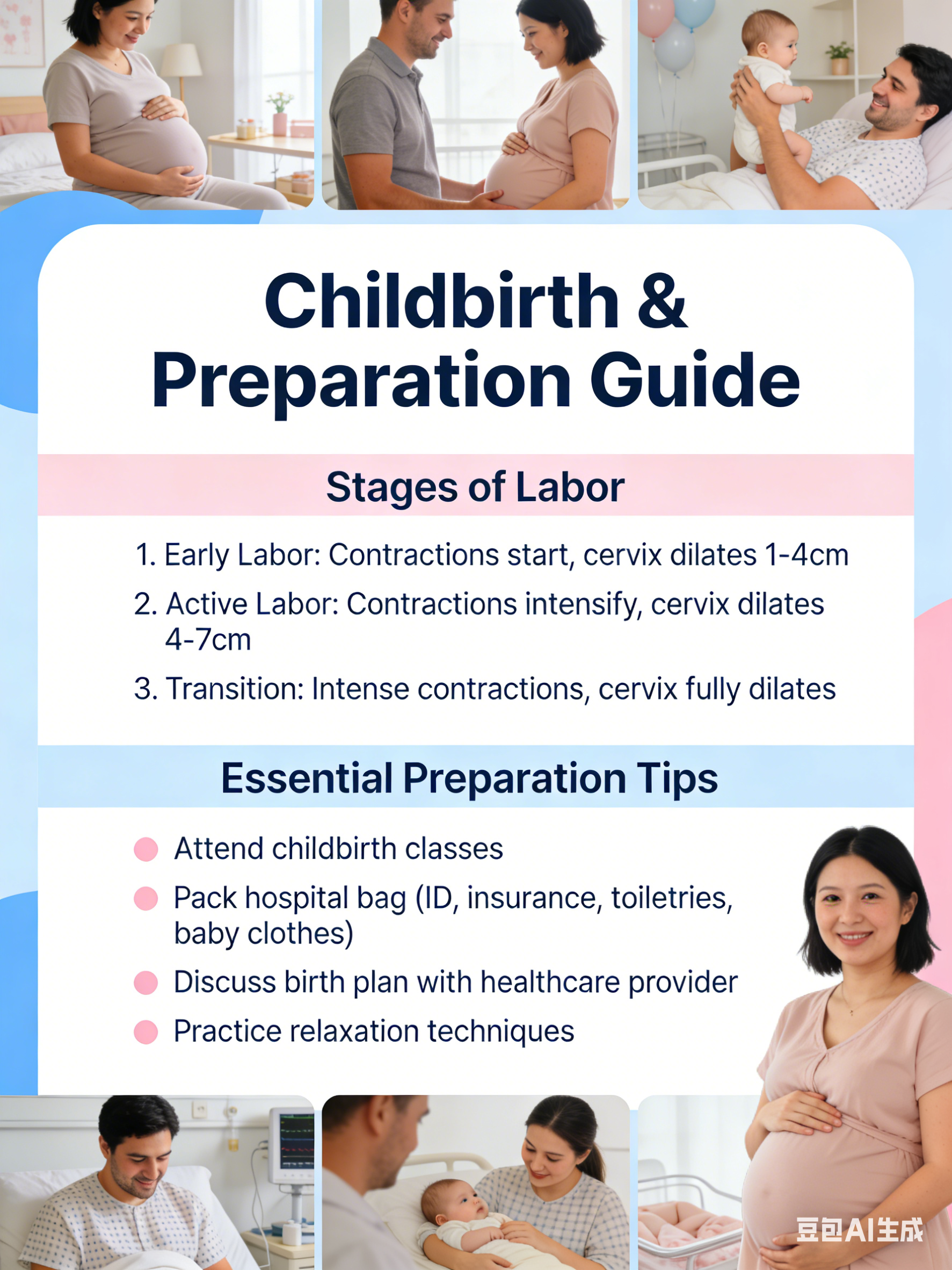




Preparing for Childbirth (Part 1): A Professional Guide to Labour and Delivery Interventions
Understanding the potential interventions and complications during childbirth can help expectant parents feel more prepared and empowered. This guide provides evidence-based information on common procedures and situations that may arise during labour and delivery.
*Disclaimer: This information is for educational purposes only and does not replace professional medical advice. Always consult your midwife, obstetrician, or healthcare provider for guidance specific to your pregnancy.*
1. Episiotomy
Definition: A surgical incision made in the perineum (the area between the vaginal opening and anus) to enlarge the vaginal opening during delivery .
Indications: Routine episiotomy is no longer recommended. Current evidence supports selective use only when clinically indicated :
– Fetal distress: When immediate delivery is needed due to abnormal fetal heart rate patterns
– Instrumental delivery: During forceps or vacuum-assisted births
– Rigid perineum: When the perineal tissue is inelastic and severe tearing appears inevitable
– Shoulder dystocia: To create additional space for delivery
– Maternal exhaustion: When prolonged pushing is detrimental to maternal wellbeing
Procedure: Usually performed under local anaesthetic or with existing epidural analgesia. The most common technique is a mediolateral incision (angled to the side) .
Post-operative care :
– Position: Lie on the opposite side to the incision to reduce lochia contamination
– Hygiene: Clean the area after each toilet visit and keep dry
– Pain management: Ice packs (first 24-48 hours), simple analgesia as advised
– Monitor for infection: Seek help if redness, swelling, warmth, or discharge develops
– Avoid sexual intercourse until reviewed at 6-week postnatal check
2. Urinary Catheterisation
Definition: Insertion of a flexible tube (catheter) through the urethra into the bladder to drain urine .
Indications during childbirth and postpartum :
– Labour management: To empty the bladder before instrumental delivery or caesarean section
– Urinary retention: Inability to pass urine after delivery (common due to perineal oedema, pain, or epidural effects)
– Monitoring: Accurate measurement of urine output in women with pre-eclampsia, haemorrhage, or other complications
– Immobility: Following complicated deliveries or regional anaesthesia
Procedure: Performed using sterile technique. A 12-14F Foley catheter is typically used. The balloon is inflated with 5-10mL sterile water once in position .
Postpartum care :
– Maintain sterile closed drainage system
– Ensure catheter is secured to prevent traction
– Monitor urine output and appearance
– Remove as early as clinically appropriate to reduce infection risk
– Report any suprapubic pain, fever, or cloudy urine
Complications: Urinary tract infection (most common), urethral trauma, haematuria .
3. Arrest of Labour (Prolonged/Stalled Labour)
Definition: Labour that fails to progress despite adequate uterine contractions. Diagnosis is based on specific time parameters for each stage .
Types of labour arrest :
| Type | Definition |
|---|---|
| Prolonged latent phase | Latent phase ≥16 hours |
| Prolonged active phase | Active phase ≥8 hours |
| Active phase arrest | No cervical dilation for ≥2 hours after entering active phase |
| Second stage prolongation | Nulliparous: >2 hours; Multiparous: >1 hour |
| Second stage arrest | No descent for ≥1 hour |
| Protracted descent | Descent <1 cm/hour in late active phase |
| Prolonged labour (dystocia) | Total labour >24 hours |
Causes:
– Uterine factors: Inadequate or uncoordinated contractions
– Fetal factors: Malposition (occiput posterior), malpresentation, macrosomia
– Pelvic factors: Cephalopelvic disproportion (CPD)
*Management :
– Assess for CPD or malposition requiring caesarean section
– Artificial rupture of membranes (if intact)
– Oxytocin augmentation for hypotonic contractions
– For uncoordinated contractions: Rest with sedation, discontinue oxytocin if in use
– Second stage management: If head is low enough (station ≥+3), instrumental delivery; otherwise caesarean section
4. Postpartum Haemorrhage (PPH)
Definition: Blood loss ≥500 mL within 24 hours of vaginal birth, or ≥1000 mL following caesarean section .
Incidence: Affects 5-18% of deliveries; a leading cause of maternal mortality worldwide .
Risk factors :
– Advanced maternal age (≥35 years)
– Multiple pregnancy, polyhydramnios
– Prolonged labour, augmented labour
– Previous PPH, placental abnormalities
– Pre-eclampsia, coagulation disorders
Early warning signs :
– Bleeding: Soaking one pad every 15 minutes, continuous trickle, or sudden gush
– Vital signs: Tachycardia (>100 bpm), hypotension (systolic <90 mmHg or drop ≥30 mmHg)
– Symptoms: Dizziness, lightheadedness, pallor, cool clammy skin, nausea
– Uterine assessment: Boggy, poorly contracted uterus; rising fundal height suggests intrauterine clot
Emergency management (while awaiting medical assistance) :
1. Position: Lay mother flat, elevate legs 30° (shock position), turn head to side
2. Uterine massage: Rub fundus in circular motion to stimulate contraction
3. Empty bladder: Encourage voiding or catheterise (full bladder inhibits contraction)
4. Keep warm: Cover with blankets
5. Monitor and record: Note time of onset, estimated blood loss, vital signs
Definitive treatment: Uterotonics (oxytocin, ergometrine), tranexamic acid, fluid resuscitation, blood transfusion, surgical interventions if required.
5. Placenta Delivery and Management
Normal third stage: Placenta typically delivers spontaneously within 5-15 minutes of birth .
Active management of third stage:
– Prophylactic uterotonic (oxytocin) administered
– Controlled cord traction
– Reduces risk of PPH by 60%
Physiological management:
– No routine oxytocics, placenta delivered by maternal effort
– Suitable for low-risk women who prefer minimal intervention
Retained placenta: Failure to deliver placenta within 30 minutes (active) or 60 minutes (physiological). Requires manual removal under anaesthesia .
Manual removal of placenta :
– Hand inserted through vagina into uterus
– Gentle dissection of placental attachment
– Reported by many women as intensely uncomfortable despite analgesia
Maternal rights: Women may take their placenta home (for burial, ceremonial purposes) if no infectious disease contraindications exist .
Placenta consumption (placentophagy):** Not recommended. No scientific evidence supports health benefits; potential risks include bacterial/viral infection and toxin exposure .
6. Prodromal Labour (Pre-Labour / False Labour)
Definition: An early phase of labour characterised by painful, irregular contractions that do not produce significant cervical change .
Distinguishing from active labour :
| Feature | Prodromal Labour | Active Labour |
|---|---|---|
| Contractions | Irregular, may stop and start | Regular, progressively stronger |
| Cervical change | Minimal to none | Progressive dilation |
| Duration | Hours to days | Progressive until delivery |
| Response to rest | May cease with rest/position change | Continues regardless |
Causes :
– Hormonal changes (oxytocin release, prostaglandins)
– Fetal position (occiput posterior, breech)
– Cervical ripening process
– Dehydration, fatigue
– Stress or anxiety
Management strategies :
– Rest and hydration (fatigue worsens contractions)
– Warm baths/showers
– Position changes, gentle walking
– Relaxation techniques, breathing exercises
– Simple analgesia if required (paracetamol)
When to seek help :
– Rupture of membranes
– Vaginal bleeding
– Reduced fetal movements
– Regular, increasingly strong contractions
– Pain becoming unmanageable
– Gestation <37 weeks
7. Induction of Labour (IOL)
Definition: Artificial initiation of uterine contractions before spontaneous labour begins .
Indications :
– Post-term pregnancy: ≥41 weeks gestation
– Premature rupture of membranes: Prolonged rupture without spontaneous labour
– Maternal medical conditions: Diabetes (requiring medication), hypertension, renal disease, obesity (BMI ≥30)
– Fetal concerns: Growth restriction, oligohydramnios
– Placental issues: Placental abruption, placenta praevia
– Chorioamnionitis: Intrauterine infection
Methods:
1. Pharmacological:
– Prostaglandins (cervical ripening)
– Oxytocin infusion (for uterine stimulation)
2. Mechanical:
– Artificial rupture of membranes (amniotomy)
– Balloon catheter (Foley)
Oxytocin administration :
– Intravenous infusion with low starting dose
– Incremental increases every 15-30 minutes based on contraction pattern
– Goal: 2-3 contractions every 10 minutes, lasting 30-40 seconds
– Continuous fetal monitoring required
Timeframe: Response varies considerably (hours to >24 hours) depending on cervical readiness .
8. Common Myths About Induction
Myth 1:Induction guarantees immediate delivery
Fact: Oxytocin does not equal immediate birth. Response depends on cervical maturity, uterine sensitivity, and fetal factors .
Myth 2:Induction is always saf
Fact: Induction carries risks including failed induction (requiring caesarean), fetal heart rate changes, infection, uterine rupture (rare), and postpartum haemorrhage .
Myth 3:You can always request induction
Fact: Elective induction (without medical indication) is only offered after 39 weeks and requires careful counselling .
Myth 4: Natural methods can reliably start labour
Fact: No evidence supports exercise, sexual intercourse, or herbal supplements for labour induction. Some methods may pose risks .
Myth 5:Induction is always more painful
Fact: Induced contractions may be more intense, but effective pain relief options are available.
Myth 6:Previous caesarean means no induction
Fact: Some induction methods may be used after caesarean with careful monitoring, though uterine rupture risk exists .
**Preparation is key:** Understanding these potential interventions allows expectant parents to make informed decisions and communicate effectively with their healthcare team. Every birth journey is unique, and flexibility is essential.
*References available upon request.*
a.本站所有文章,如无特殊说明或标注,均为本站原创发布。
b.任何个人或组织,在未征得本站同意时,禁止复制、盗用、采集、发布本站内容到任何网站、书籍等各类媒体平台。
c.如若本站内容侵犯了原著者的合法权益,可联系我们进行处理。








No comments yet