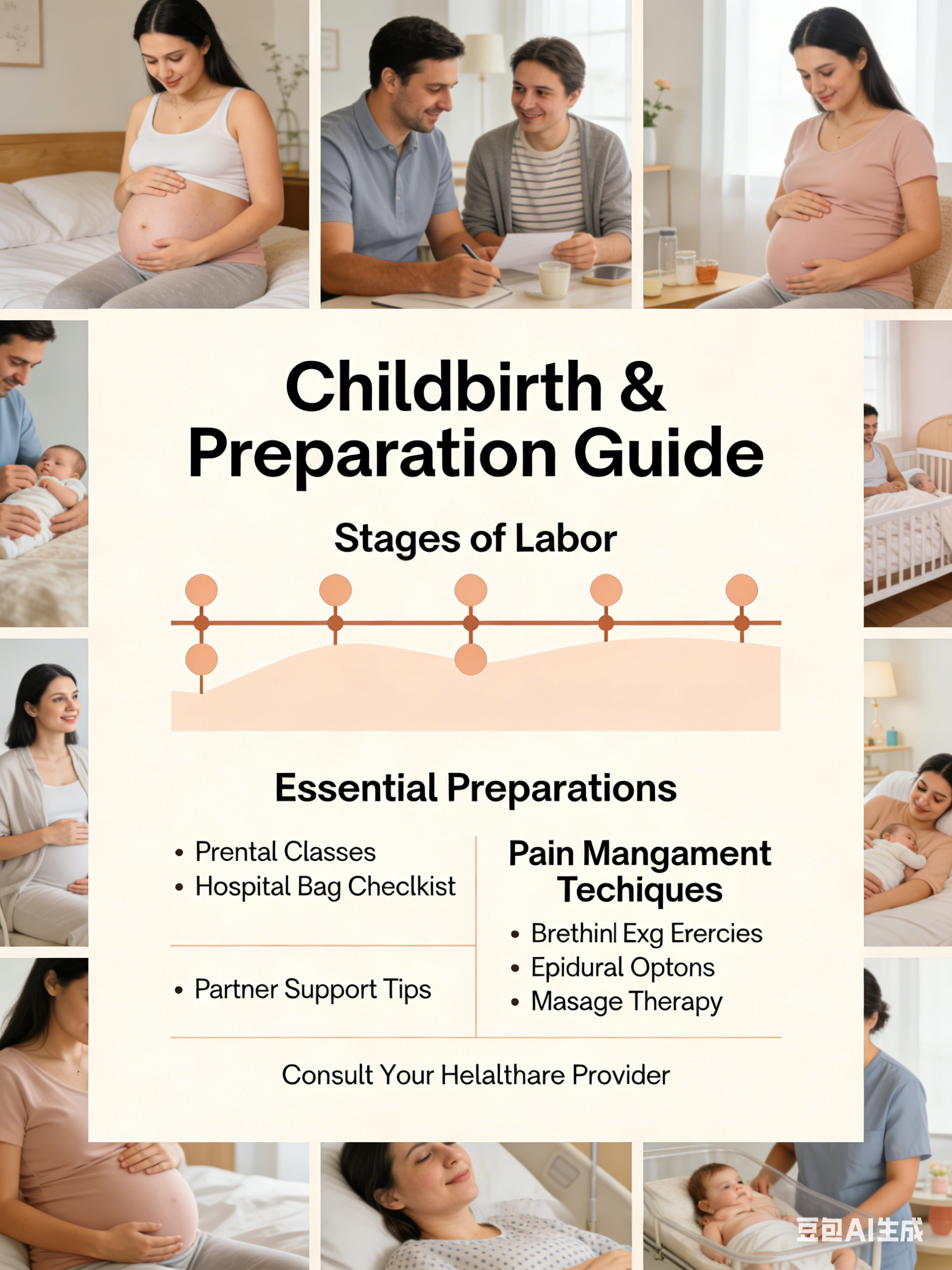




Preparing for Childbirth (Part 3): A Professional Guide to Labour Signs, Interventions, and Complications
Understanding the physical signs of progressing labour, common procedures, and potential complications can help expectant parents navigate the final stages of pregnancy and delivery with confidence. This guide provides evidence-based information on essential topics related to labour onset, cervical changes, perineal care, and rapid delivery.
*Disclaimer: This information is for educational purposes only and does not replace professional medical advice. Always consult your midwife or obstetrician for guidance specific to your pregnancy.*
1. Cervical Ripening (Cervical Maturity)
Definition: Cervical ripening refers to the process by which the cervix softens, effaces (thins), and begins to dilate in preparation for labour .
Clinical assessment (Bishop Score): Cervical readiness is assessed using the Bishop scoring system, which evaluates:
– Cervical dilation (cm)
– Cervical effacement (%)
– Cervical consistency (firm, medium, soft)
– Cervical position (posterior, mid, anterior)
– Fetal station (-3 to +3)
A Bishop score ≥6 generally indicates a favourable cervix for induction .
Methods of cervical ripening:
– Pharmacological: Prostaglandins (gels, tablets, or pessaries)
– Mechanical: Foley catheter balloon – studies show approximately 50% of women achieve a favourable cervix or onset of labour within 24 hours of balloon insertion, with rare and mild adverse events
– Outpatient ripening: Associated with decreased risk of caesarean delivery for failed induction
2. Cervical Dilation
Definition: Cervical dilation is the opening of the cervical os, measured in centimetres from 0 to 10 cm, as labour progresses.
Phases of cervical change :
– Latent phase: Slow cervical dilation (0-3/4 cm) with irregular contractions
– Active phase: More rapid dilation from 4 cm to 10 cm. Contemporary data suggests 6 cm is a better landmark for the start of active phase
– Complete dilation: 10 cm, allowing passage of the fetal head
Normal progress: The 95th percentile for time to progress from 4 cm to 5 cm is approximately 6 hours, and from 5 cm to 6 cm is over 3 hours .
3. Uterine Contractions
Definition: Rhythmic tightening and relaxing of uterine muscles that work to dilate the cervix and push the fetus down the birth canal .
Characteristics of true labour contractions :
– Regular pattern: Come closer together over time (e.g., every 5-10 minutes progressing to every 2-3 minutes)
– Duration: Last 30-70 seconds, becoming longer
– Intensity: Become progressively stronger, often described as very strong menstrual cramps or wave-like tightness
– Unrelenting: Do not stop with position change or rest
– Radiating pain: May extend to lower back and upper thighs; during a contraction, patients typically cannot walk or talk
False labour (Braxton Hicks) contractions :
– Irregular and unpredictable intervals
– Typically short and mild
– Often cease with rest or position change
– Do not cause progressive cervical change
Timing contractions: Measure from the beginning of one contraction to the beginning of the next. Contact your provider when contractions are every 5 minutes for at least 1 hour, lasting 60 seconds each .
4. Postterm Pregnancy
Definition :
– Late-term pregnancy: 41 0/7 to 41 6/7 weeks gestation
– Postterm pregnancy: ≥42 weeks gestation
Risks of prolonged pregnancy :
– Meconium-stained amniotic fluid
– Fetal macrosomia (increased birth weight) leading to higher rates of shoulder dystocia, operative delivery, and perineal trauma
– Stillbirth or neonatal death (increased after 42 weeks)
– Postmaturity syndrome: dry peeling skin, overgrown nails, reduced fat deposition
Management :
– Antenatal fetal surveillance (nonstress test or biophysical profile) starting at 41 weeks
– Induction of labour considered at 41-42 weeks, recommended after 42 weeks and no later than 42 6/7 weeks
5. Perineal Massage
Definition: Gentle stretching of the perineal tissues in preparation for vaginal delivery.
Evidence: Studies show that prenatal perineal massage can reduce the incidence of perineal trauma requiring suturing . Combined approaches (pelvic floor exercises + biotechnological devices like Epi-No) have been shown to reduce severe tears by up to 40% and episiotomies by 30% .
Timing: Can be started after 34 weeks and performed daily until delivery .
Technique:
– Wash hands thoroughly
– Use a natural lubricant (vitamin E oil, almond oil, or water-based lubricant)
– Insert thumbs approximately 1-1.5 inches into the vagina
– Gently stretch downward and sideways until a mild burning sensation is felt
– Hold stretch for 1-2 minutes, repeating daily
– Partner assistance may be helpful for reaching the area
6. Episiotomy
Definition: A surgical incision made in the perineum to enlarge the vaginal opening during delivery .
Current recommendations: Major health organisations (WHO, ACOG) recommend **restrictive use** of episiotomy rather than routine use. WHO recommends episiotomy rates should not exceed 10% . Routine episiotomy is associated with increased risk of severe perineal trauma .
Indications for selective use :
– Fetal distress requiring expedited delivery (e.g., abnormal fetal heart rate patterns)
– Prolonged second stage
– Rigid perineum impeding delivery
– Assisted vaginal delivery (forceps or vacuum)
– Shoulder dystocia
Types :
– Mediolateral: Incision angled at 60° from the posterior fourchette; associated with lower risk of anal sphincter injury but more postpartum pain
– Midline: Incision straight posterior; easier to repair but higher risk of extension to anal sphincter (OASIS)
Informed consent: Should ideally be discussed antenatally and always obtained before performing the procedure .
7. Perineal Lacerations (Tears)
Definition: Spontaneous tearing of perineal tissues during vaginal delivery. More than 50-80% of women experience some degree of perineal trauma .
Classification of perineal lacerations :
| Degree | Structures Involved |
|---|---|
| First | Superficial injury to vaginal mucosa or perineal skin only |
| Second | Involvement of perineal muscles (perineal body) but not anal sphincter |
| Third | Second-degree plus injury to anal sphincter complex. Subdivided into: 3A (<50% external sphincter torn), 3B (>50% external sphincter torn), 3C (internal and external sphincter torn) |
| Fourth | Third-degree plus injury to rectal mucosa |
OASIS (Obstetric Anal Sphincter Injuries): Refers to third- and fourth-degree lacerations, occurring in 4-11% of US vaginal deliveries .
Risk factors for severe lacerations :
– Nulliparity
– Operative vaginal delivery (forceps/vacuum)
– Midline episiotomy
– Increased fetal weight
– Persistent occiput posterior position
– Asian ethnicity
Prevention strategies :
– Perineal massage during second stage
– Warm compresses applied to perineum
– “Hands-on” perineal support
– Delayed pushing in lateral position (limited evidence)
8. Precipitous Labour (Rapid Labour)
Definition: Labour resulting in birth within **3 hours** of regular contractions beginning. Some definitions extend to <5 hours .
Incidence: Occurs in approximately 3% of all births .
Signs :
– Contractions start suddenly and are immediately close together
– Little to no buildup in intensity—contractions are strong from the outset
– Intense urge to push (described as feeling like needing to have a bowel movement)
Risk factors :
– Previous precipitous labour
– Prior vaginal birth
– Small baby
– Exceptionally strong uterine contractions
– Compliant birth canal
– Hypertension
– Labour induction with prostaglandins
Complications :
– For mother: Postpartum haemorrhage, shock, severe perineal tears, retained placenta, delivery in unsterile environment, emotional distress
– For baby: Meconium aspiration, infection (if unsterile delivery), birth injury
What to do if precipitous labour is suspected :
– Call obstetrician or emergency services immediately
– Stay calm, practice deep breathing
– Ensure someone remains with you
– Lie on left side
– Try to keep area clean
– Have hospital bags ready from 36 weeks
9. Bloody Show
Definition: Passage of the mucous plug that sealed the cervix during pregnancy, often tinged with blood (brownish or pink-tinged discharge) .
Significance: Indicates that the cervix has begun to dilate and efface. Active labour may still be hours or days away .
Clinical context: Often accompanies other pre-labour signs such as lightening (baby dropping into pelvis), increased pelvic pressure, and diarrhoea .
When to seek care: Contact provider if bleeding is heavy (more than spotting) or accompanied by decreased fetal movement or ruptured membranes.
10. Lamaze Breathing Techniques
Definition: A structured approach to breathing during labour designed to promote relaxation, reduce pain perception, and enhance coping .
Training onset: Typically begins around 7 months gestation, practised with a partner at home .
Five key techniques :
| Technique | Timing/Stage | Method |
|---|---|---|
| 1. Slow-paced breathing | Early labour (3 cm dilation, contractions 5-6 min apart) | Deep breath in through nose, exhale slowly through mouth. Begin/end with cleansing breath. |
| 2. “Hee-hee” light breathing | Active labour (8 cm dilation, intense contractions 2 min apart) | Shallow breaths in/out through mouth, keeping upper chest still. Creates “hee-hee” sound in throat. |
| 3. Variable-rate breathing | Transition (8-10 cm, strongest contractions) | Pattern changes with contraction intensity; may combine slow and light breathing as needed. |
| 4. Pant-blow breathing | When urge to push before full dilation | Short pants followed by blow; helps resist pushing until cervix fully dilated. |
| 5. Pushing breaths | Second stage (fully dilated) | Take deep breath, hold, bear down as if having a bowel movement. Release and repeat with each contraction. |
Benefits : Pain reduction, decreased anxiety, shorter labour duration, enhanced sense of control, partner involvement in birth process.
Summary Table: Signs Distinguishing True vs False Labour
| Feature | True Labour | False Labour |
|---|---|---|
| Contraction pattern | Regular, increasing frequency | Irregular, no pattern |
| Duration | 30-70 seconds, lengthening | Variable, often short |
| Intensity | Progressively stronger | Mild, doesn’t intensify |
| Effect of movement | Continues regardless | Often stops with rest/position change |
| Cervical change | Progressive dilation/effacement | No significant change |
| Discomfort | Entire abdomen, radiates to back | Often only lower abdomen |
**References available upon request.**
a.本站所有文章,如无特殊说明或标注,均为本站原创发布。
b.任何个人或组织,在未征得本站同意时,禁止复制、盗用、采集、发布本站内容到任何网站、书籍等各类媒体平台。
c.如若本站内容侵犯了原著者的合法权益,可联系我们进行处理。









No comments yet